



Landbridge, Thailand’s US$31 billion logistics megaproject, has been revived by the current government, amid the Strait of Hormuz closure and geopolitical conflict. These external shocks have handed the government a timely pretext to make a strong case for revival.
Key point
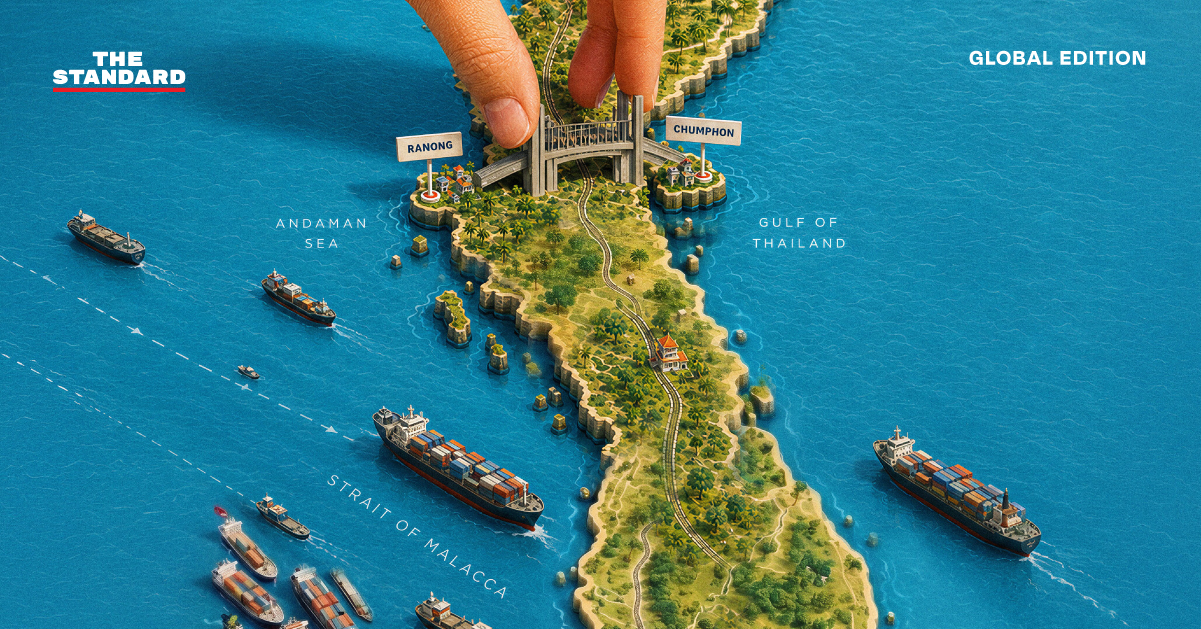
Thailand has spent more than a century dreaming of a shortcut across its Southern Peninsula. The Landbridge, linking the Gulf of Thailand at Chumphon to the Andaman Sea at Ranong, is the most ambitious expression. An 89-kilometer overland corridor made up of motorways, double-track railways, and energy pipelines designed to move cargo between the Indian and Pacific Oceans.
The vision is to attract large-scale foreign investment across ports, industrial estates, and energy infrastructure, and turn the South into a logistics hub on par with the Eastern Economic Corridor.
The canal concept has evolved in name and rationale with each administration, but the ambition has never translated into anything beyond lofty goals due to factors such as high cost and politics itself.
As the world continues to reel from the Strait of Hormuz closure and associated conflict, the strategic rationale behind Landbridge may be understandable, but the commercial viability is harder to justify.
For Thailand, Landbridge isn’t merely an infrastructure proposal, but a question of national positioning. Will the country be able to leverage its geographical position without mistaking ambition for a strategic value proposition?
Geo-Political Crisis to Opportunity? The 90 Day Challenge
The Landbridge project has returned to the Cabinet agenda. The government’s rationale is that the world itself has shifted, even if the megaproject itself has not. Under Prime Minister Anutin Charnvirakul, Minister of Finance and Deputy Prime Minister Ekniti Nitithanprapas has been appointed to chair a study committee to conduct a feasibility study within 90 days. The mandate is to assess the project against four realities: economic, environmental, social, and geopolitical.
Recent global uncertainties have made chokepoint anxiety the new vocabulary of modern trade. Governments and businesses are seeking to diversify their supply chains, and Thailand wants to seize this opportunity.
There is a trap within the opportunity. A more politically volatile world may lend credence to its argument, but it does not automatically strengthen the megaproject’s commercial viability.
The 90-day review must be a stress test, not a formality to justify ambitions. The central question is whether the Landbridge works in ordinary times, when shipping lines choose routes on cost and reliability, not geopolitical anxiety. Thailand risks building on a shortcut and belief that future crises will eventually validate it.
The Strait of Malacca and Regional Competitiveness
This is the underlying argument against it all. The Strait of Malacca, a waterway between the Malay Peninsula and Indonesia’s Sumatra Island, connects the Indian Ocean and the Pacific Ocean, and remains one of the world’s most important shipping lanes.
Malacca is a vital route connecting commerce among East Asia, the Middle East, and Europe. China’s dependence on it has long been labeled the Malacca Dilemma, but traffic through the strait has continued to grow. Therefore, Landbridge is unlikely to emerge as a replacement. At best, it could be an option, a contingency route with the appeal of a convenient fire exit.
There are regional comparisons. Singapore has invested decades in building an entire maritime services economy. Thailand would be challenging a leading incumbent with a multi-decade head start.
Malaysia’s ECRL is worth watching. The 665-kilometer railway linking Port Klang to Kota Bharu, a similar overland shortcut across the peninsula, is over 80% complete, with Chinese investment, and is already receiving trains. The project is ready to deliver, whilst Thailand continues its debates.
Thailand must weigh the political dynamics between global superpowers. The infrastructure may sit at the intersection of Chinese and American interests. How will the country navigate this balancing act?
Lessons From Panama
In the age of containerized shipping, Landbridge routes rarely replaced sea shipping continuously at scale. The closest comparison is the Panama Canal Railway, which runs alongside one of the world’s most vital inter-ocean waterways. Its capacity stands approximately 900,000 TEU annually, whilst the canal it runs beside moves multiples of that.
Thailand’s Landbridge sets its sights considerably higher. Project documents cite a long-term port capacity of up to 20 million TEU per port, for a combined total of 40 million TEU. Even its own assumptions concede that volumes will fall significantly short of that in the early years.
The core challenge of Landbridge is the double-handling. Cargo must be unloaded from one vessel, moved overland, and loaded onto another. When berthing time, rail scheduling, vessel coordination, and the delays of a two-port system are accounted for, the four-day time saving may not be worthwhile.
Contradictions Within the State
The most revealing case against Landbridge comes from within, as institutions cannot agree on whether it makes sense.
The Office of Transport and Traffic Policy and Planning, under the Ministry of Transport, previously reported an Economic Internal Rate of Return of 17.43%, projects 280,000 jobs, and estimates a four-day reduction in shipping time on certain routes. In contrast, prior research by the National Economic and Social Development Council (NESDC) reached the opposite conclusion: a negative NPV.
The Thailand Development Research Institute (TDRI) has also warned that megaprojects tend to fail due to excessive optimism and political pressure.
Another reality is that global trade may not thrive at the same levels seen decades prior; Thailand may be prepping for a former version of trade.
This raises the critical question of whether megaprojects in Thailand are vetted with factual evidence or simply greenlit on a whim.
Strategic Autonomy Or Strategic Capture
Every powerful nation reads this differently. For China, any credible alternative to Malacca carries strategic weight. For India, it could complement the country’s own eastward connectivity ambitions. For powers such as the US and Europe, a diversified logistics network in Southeast Asia aligns with their agenda of supply-chain resilience.
For Thailand, the singular prize is strategic autonomy. The risk? Strategic capture.
If a megaproject relies too heavily on a single investor, particularly one with its own national agenda, global powers will not view it as a neutral commercial corridor, thereby weakening Thailand’s position.
In a game of strategic diplomacy, Landbridge must remain Thailand’s project, not merely Thailand’s territory used to serve others’ ambitions.
The minimum conditions are a diversified investor base, transparent governance, and credible state guarantees that no single country can influence agendas.
The Existing Ecosystem: Assessing The Environmental Impact
For environmentalists, the key concern is the current ecosystem in which Landbridge will be constructed. The corridor runs through areas where fishing, tourism, forestry, and coastal ecosystems are already in place.
An assessment by Chulalongkorn University cites that the project risks encroaching on national forest reserves, the Khuan Mae Yai Mon wildlife sanctuary, and internationally protected wetlands at the mouth of the Kapeung Canal.
A strategic environmental assessment should thoroughly evaluate the project’s cumulative impact across the entire Southern Peninsula, including the industrial footprint that typically accompanies development of this scale.
For communities in Chumphorn and Ranong, it’s more than data points; it’s their livelihoods.
It’s important to assess whether Landbridge will uplift local communities or, rather, fulfill the interests of large capital.
The Looming Question
The key question is not whether Thailand can build Landbridge, but how the country can position itself in the new world order and upskill its own strategic infrastructure to shape the flow of global trade.
The concern is whether such ambitions are grounded in realities that can contend with geopolitical intricacies, market dynamics, and regional competitiveness.
Beneath it all lies an ambitious question. Landbridge is being debated as either the opportunity of a century or a national-scale risk. Thailand must thoroughly assess the megaproject’s value through a global lens, not lofty political ambitions.
THE STANDARD Global Edition is produced in collaboration with Bitesize Bangkok.
Key Takeaway: What to Know About Landbridge
What is Landbridge?
A proposed 89km overland corridor connecting the Gulf of Thailand to the Andaman Sea via deep-sea ports, motorways, double-track railways, and energy pipelines with a US$31 billion price tag.
Why has the proposal returned?
Recent geopolitical shocks, such as the Strait of Hormuz closure, serve as a timely pretext to revive the project.
What is the government doing now?
Finance Minister Ekniti Nitithanprapas has been tasked with a 90-day feasibility study against four realities: economic, environmental, social, and geopolitical.