



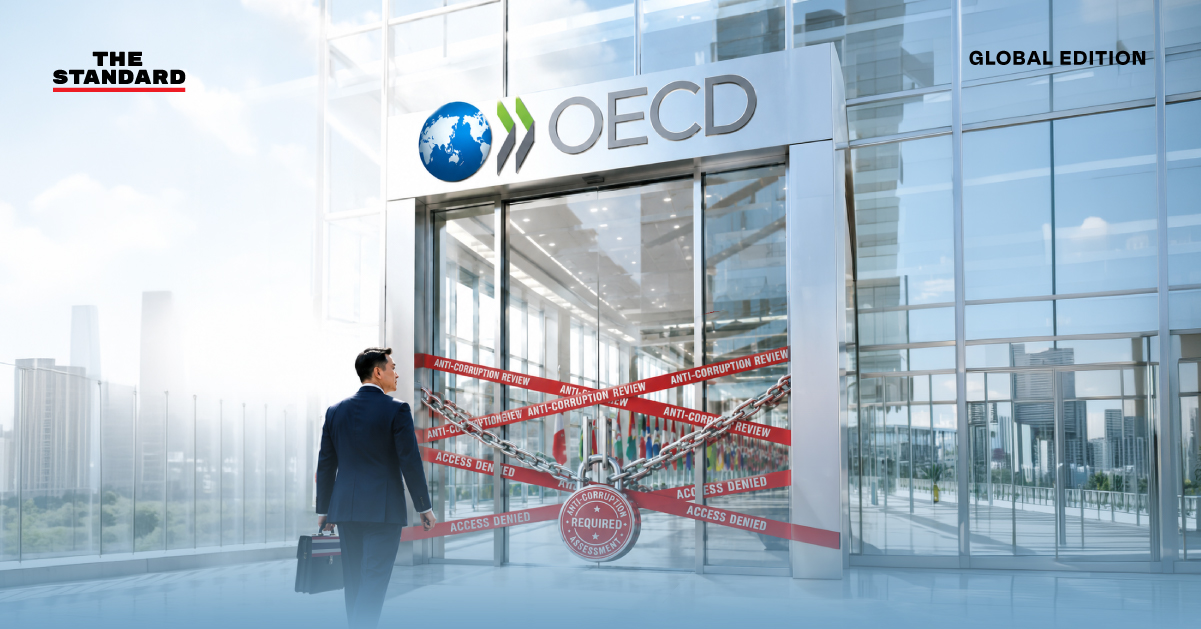
Corruption at a Cost: Thailand’s Governance Problem
Amid goals to reposition itself within an increasingly complex and competitive world order, Thailand is on a challenging path to attract a new wave of investments across emerging verticals, free itself from the middle-income trap that has long caged its population, and finally pave the way towards OECD membership.
Key point
Thailand’s limitations may not be its geographical location or its private-sector capabilities. The country’s biggest constraint is the quality of its governance and laws.
The country has seen an abundance of headlines this past week, from a private-sector report on corruption’s impact on businesses to the government’s newly established anti-corruption committee to a private meeting between business leaders and Prime Minister Anutin Charnvirakul, and the government’s OECD ambitions. Look closely, and a pattern emerges; they’re part of the same narrative.
Thailand is finding itself increasingly under pressure to enforce rules and regulations. Corruption is not merely a moral failing of the state but a structural flaw that undermines economic growth and credibility, hindering Thailand’s ability to compete globally.
Corruption: Thailand’s Hidden Tax
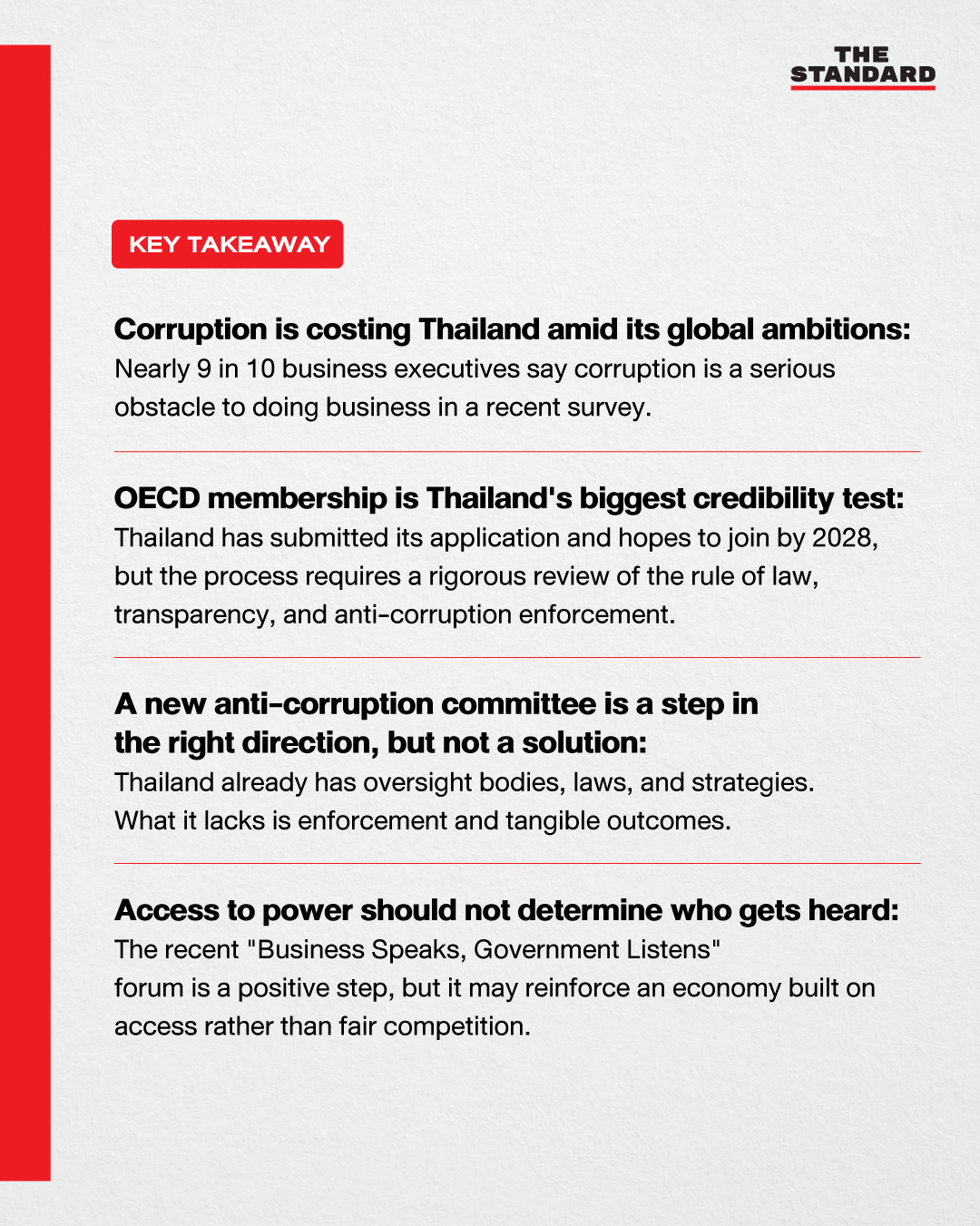
A recent survey by Thailand’s Joint Standing Committee on Commerce, Industry and Banking (JSCCIB) paints a troubling picture. Among 401 surveyed business executives and representatives, 89.1% cited corruption as a moderate to serious obstacle to doing business, while unofficial payments in government-related contracts were estimated at around 11-15% of contract value.
This data point quantifies corruption and points to a systemic problem that goes beyond hushed scandals or random misconduct; there’s a structural cost on economic growth.
It’s a familiar story in Thailand. Entrepreneurs pay to expedite lengthy processes, business owners pay to secure contracts, and so forth. This has created an ecosystem in which access to bureaucracy overrides innovation and competition.
In today’s hyper-competitive landscape, countries seeking to attract capital to fuel future-forward ambitions in data centers, semiconductors, and clean energy cannot rely on tax incentives alone. Variables such as governance and state transparency are key to building international credibility, which is central to Thailand’s current ambitions to join the Organization for Economic Co-operation and Development (OECD).
Thailand’s OECD Ambitions
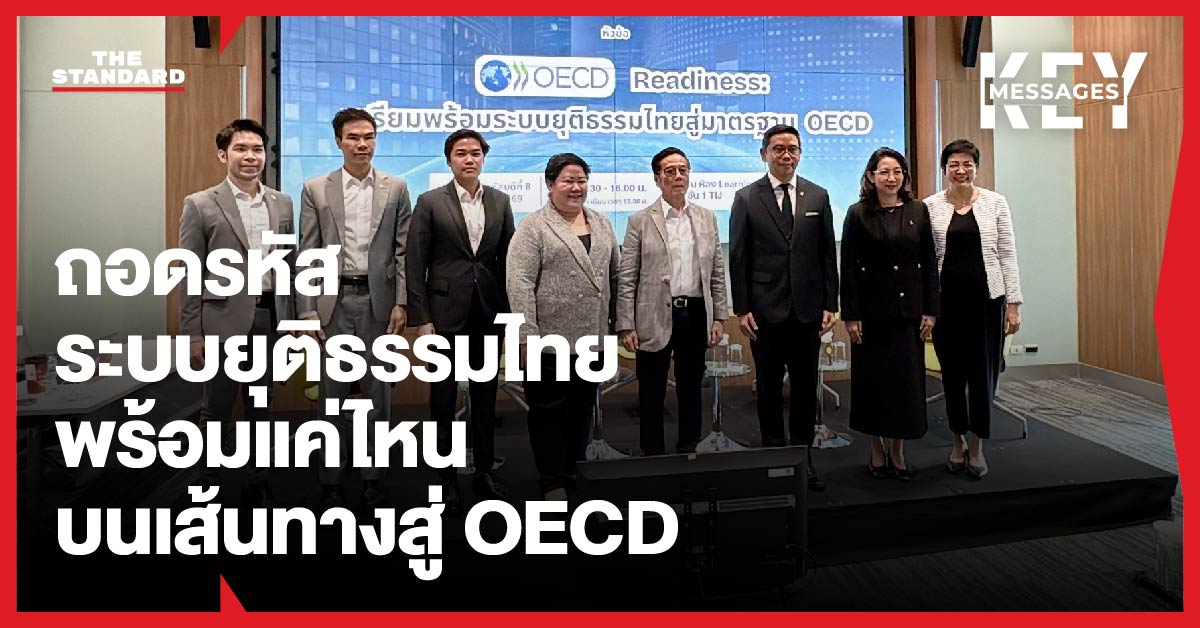
Thailand has its sights set on prestigious OECD membership, an organization that serves as a policy forum for economic growth and sets the global standard for economic, trade, and government transparency. Thailand submitted its initial memorandum last year, thereby launching a technical review involving 25 expert committees, with hopes of joining by 2028. The OECD’s multi-year accession process requires a thorough review of the rule of law, human rights, corruption, and public-sector transparency.
For Thailand, the OECD serves as a benchmark on the world stage and the means to uplift its economic standing. The mission to join is akin to a diplomatic checklist, a trophy that the current government can claim as its success. On a larger scale, Thailand’s quest to join highlights its regional ambitions amid rising competition, its aim to remain relevant in the new geopolitical order, and, ultimately, a need for credibility to attract foreign investment. The OECD will assess Thailand’s anti-corruption enforcement, particularly bribery, public-sector transparency, procurement, and law enforcement.
It’s standing across international indices shows the challenge. The World Justice Project reports that Thailand’s Rule of Law Index 2025 is ranked 77th out of 143 countries, highlighting that corruption is not separate from the rule of law. Academics and the private sector warn that structural corruption is nearly impossible to eradicate, hindering the country’s admission to the organization.
The underlying irony here is that the political system pursuing membership is also the system that must be reformed to achieve it.
Meaningful enforcement of anti-corruption practices is, therefore, a prerequisite for thriving in the new world order.
A Committee Sends The Right Signal, But Is It Enough?
An Anti-Corruption Coordination Committee has been established to demonstrate Thailand’s commitment to reform. It sends a positive signal, particularly by fusing the public, private, and civil sectors to close bureaucratic loopholes and promote data transparency.
The looming question remains whether a committee will meaningfully change the state’s structure, given how deeply rooted corruption is. If not enforced, a committee will become just another attempt to window-dress the issue at hand.
Thailand does not lack oversight bodies, laws, or anti-corruption strategies. What it lacks are tangible outcomes that businesses and citizens see in reality.
CEOs and Accessibility
The ‘Business Speaks, Government Listens’ forum on May 15th carries a positive signal, as the government will benefit from hearing on-ground stories from businesses. However, there is a risk to this relationship. Problem-solving becomes contingent on access, and whoever has a seat can push their agendas into policy behind closed doors.
Continuing this will create even wider gaps and reinforce Thailand’s access-based economy.
Public Confidence Over Public Funds
The government’s 400 billion baht borrowing decree under an emergency clause may be framed as a political necessity amid deepening global shocks and a weakened domestic outlook, but public trust should be taken into account.
For a country already under scrutiny for transparency, large-scale public spending must meet a higher standard of accountability. The government should exercise fiscal discipline to enhance credibility, not attract scrutiny about vague deployment and unmeasured outcomes.
The state must be able to accept public scrutiny and demonstrate its commitment to transparency and disclosure, especially as the funds are not intended as a short-term stimulus but rather for relief and long-term energy reform.
Thailand’s Future Depends on Rule Enforcement
Thailand certainly does not lack global ambition. The country wishes to be an investment hub, attract new growth engines, and lift itself out of the middle-income trap whilst building credibility with the OECD.
Unfortunately, ambition alone cannot propel Thailand towards growth if governance fails.
In an era of supply-chain reorganization under immense geopolitical pressure, investors are seeking economies with clear governance and rule of law, and states that uphold transparency without hidden cost structures.
Thailand has acknowledged the challenge at hand. Businesses have spoken out, and international indices provide evidence in the data. The OECD committee itself will serve as a continuous framework for assessment.
The remaining question is whether Thailand can finally turn around and take meaningful action to enforce accountability. The country can only thrive on the state’s commitment to governance and enforcing the rules of law.