




Durian has become the most talked-about fruit in Thailand this past week, sparking conversations in the media and on social platforms.
Key point
It began with a Live Video selling 100 Baht durian at the center, an initiative of Commerce Minister and Deputy Prime Minister Suphajee Suthumpun. At first glance, the discourse seems to revolve around the state, influencers, and durian farmers.
Step back, and this conflict is about something larger than price. It’s about the extent to which Thailand commands pricing authority over its export commodities and how much power it wields to negotiate on equal terms with relevant markets.
The Durian Context: Livestream as a mirror to our challenges
To understand the extent of this conflict, it’s important to factor in durian’s significance to Thailand’s export sector. 75% of Thailand’s durian supply is exported abroad, primarily to China. This means the fruit is one of Thailand’s most significant agricultural export commodities. In 2025, Thailand exported fresh durian to global markets worth 125,737 million baht, up 15.71% year-on-year. In January 2026 alone, fresh durian exports were valued at 10,316 million baht, up 67% from the same period in 2025. The Ministry of Commerce’s now-viral campaign began with an announcement to livestream the sale of 1 million durians at 100 baht per fruit. The Ministry stated that this year’s durian output is expected to reach 2 million tonnes, with Live Commerce introduced as a necessary marketing tool to support widespread distribution and prevent future oversupply.
The complexities of the campaign centered on how price signals were communicated and endorsed by the government in a sensitive market. The campaign, built and hyped around a low price point, sent immediate ripples through the market. Feedback from durian growers and operators, reported by BBC Thai, points to the core issue of ‘price signaling’ and ‘market credibility’. There are intricacies to export-grade durian that go beyond what’s shown on mobile screens.
The Live controversy is more than a viral dispute; it reveals a structural dilemma Thailand will continue to encounter in the new global trade order: how to grow without surrendering control over prices, standards, and terms.
Exports Are Growing, But At What Cost?
Step back from the durian controversy, and the broader export landscape reveals some contradictions. Whilst Thailand may be selling more to its trade partners, it isn’t fully capturing the opportunity.
A scan of Thailand’s March 2026 export figures appears strong. Exports grew 18.7% to US$35.16 billion, whilst Q1 exports expanded by 17.6% to US$96.17 billion. Industrial goods have fueled most of the export surge; notable sectors include electronics, electrical appliances, and verticals tied to AI infrastructure, data centers, and the global tech supply chain. Notably, mobile phones and related components saw a staggering 166.6% increase.
Now, this is where the figures reveal a more complex narrative. In the same period, imports expanded by 32.4% in Q1 alone, leaving Thailand with a trade deficit of almost US$9.47 billion in just three months of the year.
Thailand’s exports are showing positive trends; electronics and tech components are growing, but most of that growth is driven by assembly and processing, not design, product ownership, or home-grown innovation. Thailand imports the raw components of proprietary technology and advanced parts from elsewhere, assembles them, and exports the product.
Thailand is capturing the middle of the lucrative value chain, the labor and processing, but is missing out on the real value, as the intellectual property is owned elsewhere. It goes back to Thailand’s structural challenge, because whilst the country is still relevant in the new global supply chain, much of the growth in electronics is tied to multinational corporations and not Thai-grown companies.
Durian and electronics may be industries apart, but the challenges reflect the same fundamental question.
Section 301: Establishing Thailand’s Negotiation Power
Commerce Minister Suphajee’s upcoming trip to Washington, DC, from 13-14 May is an opportunity to establish Thailand’s role in the new global order.
The United States is seeking a new legal basis to replace existing tariff measures, set to expire on July 24. Separately, it is also planning to deploy Section 301 and other national security laws to reimpose more targeted tariffs.
This is the new operating reality of global trade. Countries seeking continued access to the United States market must now work within a playbook that is being actively rewritten. The question is how much leverage Thailand can realistically deploy to defend its prices and preserve the autonomy it will need to compete on its own terms.
Thailand will be tasked with providing concrete data to refute allegations of low capacity utilization rates and to demonstrate that this is the result of a market-driven decline in production, rather than state subsidies driving private-sector overinvestment.
The real challenge here is not to cave to demands that may encroach on Thailand’s sovereignty and strategic alliances. If Thailand accepts restrictions on who it can trade with or what agreements it can pursue, it trades a short-term relief for a long-term strategic constraint, one that will be harder to maneuver out of.
Thailand’s best-case scenario is maintaining the tariff ceiling at 19% and ensuring that the country is not penalized at a higher rate than ASEAN peers, thereby preserving its competitive edge and potentially enabling Thailand to capture market share once dominated by China.
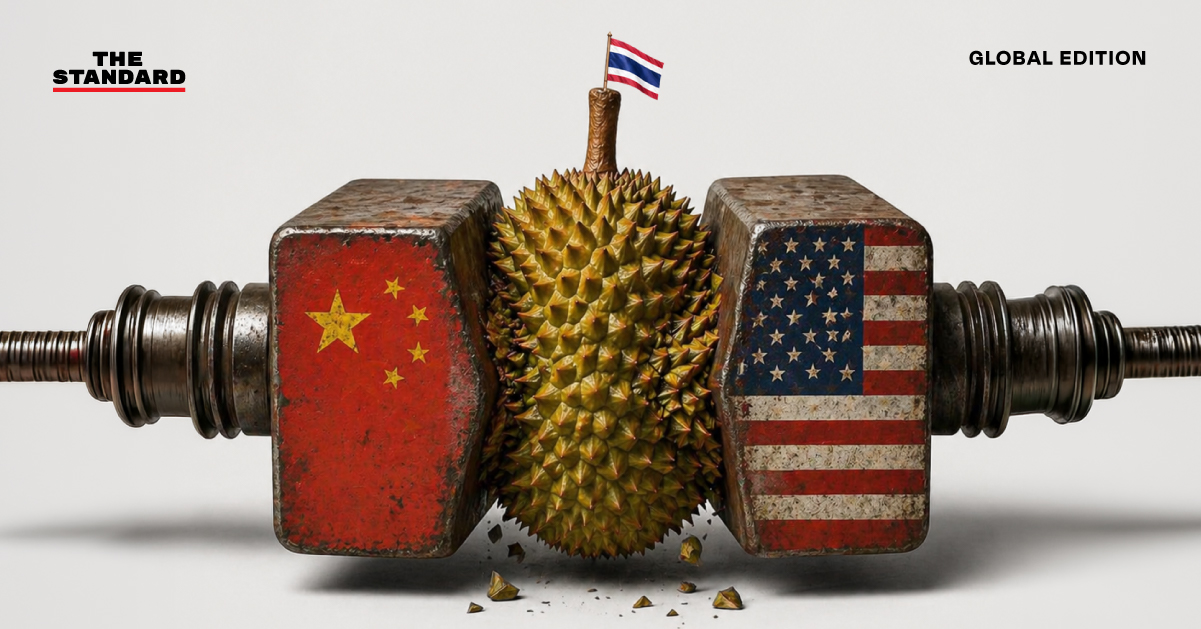
Strategic Positioning: Establishing a Place Between the US and China
To successfully navigate the diplomatic chessboard, Thailand cannot afford to focus solely on the United States, because China remains a crucial partner to the country’s economy.
China is a key export destination for durian, a supplier of key components, and a major source of investment, whilst simultaneously competing with Thai businesses across key sectors such as manufacturing.
Thailand is therefore tasked with a delicate balancing act, actively leveraging its relationships with both Washington and Beijing to strengthen its position. Managing bilateral tension while pursuing Thailand’s own economic interests will require active and continuous diplomatic engagement.
The ASEAN dimension adds a layer of complexity; Thailand is also competing with regional neighbors, and whilst the 19% tariff rate is shared among peers, competitive strength is not. Vietnam offers unmatched manufacturing scale, and Indonesia holds a structural advantage in critical minerals. Thailand cannot rely on diplomatic goodwill alone.
To maintain a seat at the table, Thailand must comply with global standards through regulatory predictability, an origin-verification system, and a demonstrated ability and track record of moving up the value chain. It must work to demonstrate its competitive edge, or risk becoming a nonessential trade partner in the new global order.
Key Takeaway: Thailand Cannot Afford to Grow on Others’ Terms
Thailand has proven it can meet volumetric goals; export growth, trade partners, and headline expansions. Economic sovereignty, however, is the challenge. It needs to consistently maintain pricing power, capture value, and build credibility across the entire supply chain.
The new global trade order does not reward countries with the highest export figures; it rewards countries that provide real value through reliable production bases, delivering high-quality, traceable products, and are capable of upskilling themselves through the value chain.
Thailand’s real choice is not about which global superpower to favor. It is about whether the country can compete on its own terms or continue to participate in a game where someone else makes up the rules.