


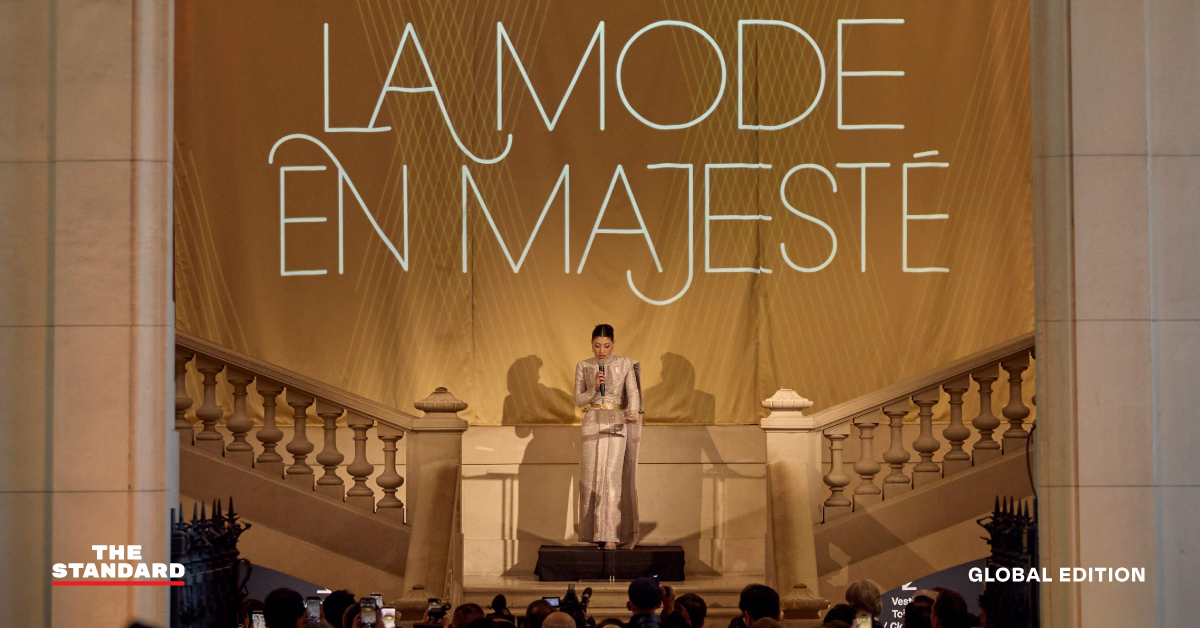
As the French capital prepares its transition to summer, warm light reflects off the cream stone of the Musée des Arts Décoratifs, the renowned art museum on the same grounds as the Louvre Palace. Guests from the blended worlds of politics and diplomatic service, arts and fashion, ascended towards the broad stone staircase into the main hall to mark the occasion. The words La Mode en Majesté hang elegantly above.
Key Point

Lighting within the exhibition rooms is calibrated to shine on each royal garment, Thai silk, and craft with precision. Each special garment is presented not as a mere item of clothing, but as living historical document through artisan expertise.
As Her Royal Highness Princess Sirivannavari Nariratana Rajakanya presided over the opening of La Mode en Majesté: Royal Thai Dress: From Tradition to Modernity exhibition, what unfolded was not merely the inauguration of a Thai fashion showcase abroad, but a significant foray of the Royal Thai Dress into one of the world’s most culturally influential stages.
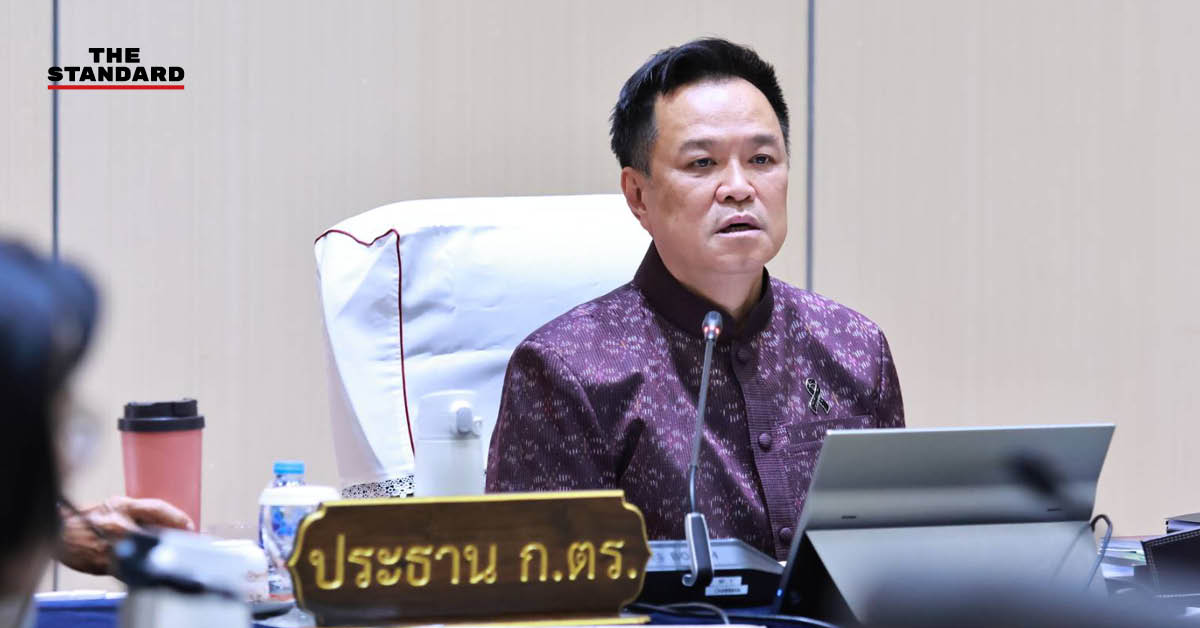
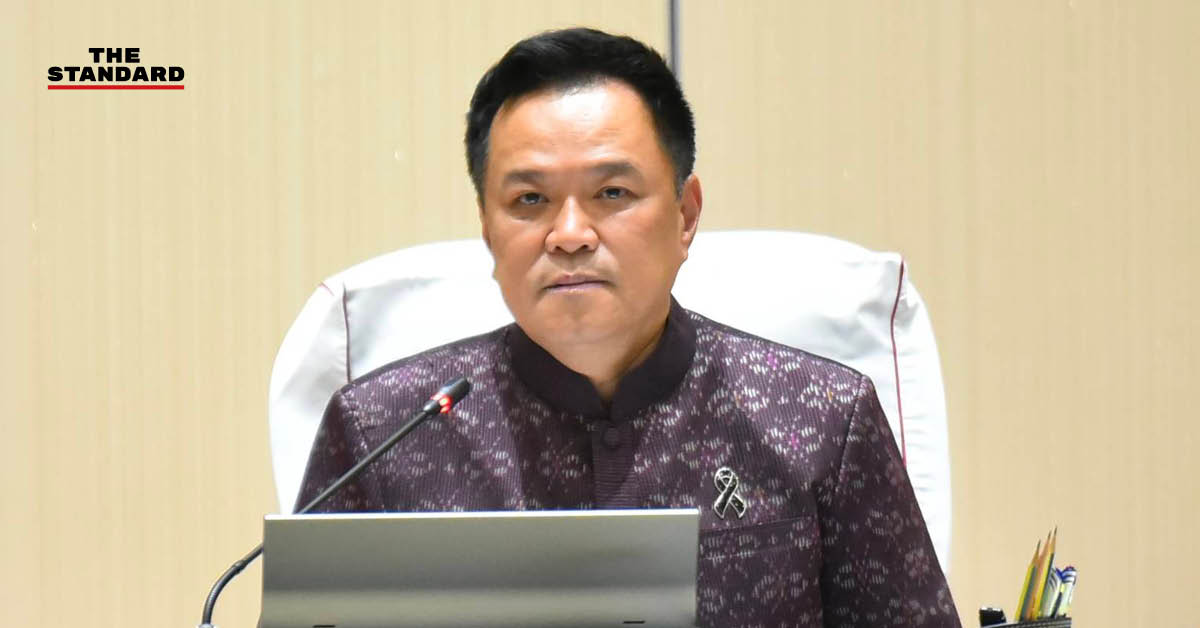
Across town at the Palais de l’Élysée, the President’s official residence, President Emmanuel Macron engaged in conversation with Prime Minister Anutin Charnvirakul in an entirely different discourse. Within the confines of the room, matters related to the Thailand–EU free trade agreement and forward-looking investments were discussed at length.
On the surface, the conversations appear entirely separate, but a closer inspection tells a different story. Both events showcase Thailand’s efforts to redefine its relationship with France through cultural expressions, diplomatic ties, and economic incentives.
An Exhibition That Transcends Beyond Fashion

Whilst La Mode en Majesté may appear to be an exhibition celebrating the beauty of the Thai dress to mark the 170th anniversary of Thai-French diplomatic relations, the true significance lies in the venue. Musée des Arts Décoratifs (MAD) is no ordinary museum, but one of France’s most influential institutions in the fields of applied arts, design, and fashion, making a showcase here a significant cultural endorsement.
In an exclusive royal interview, Her Royal Highness Princess Sirivannavari disclosed that the project took more than a year to prepare. It began with the 170th anniversary of Thai-French relations as its occasion and with the intention of presenting Thai culture in a form accessible to French audiences.


At the heart of the exhibition are the garments of Her Majesty Queen Sirikit, the Queen Mother, with a nod to Her Majesty’s collaboration with distinguished French designer Pierre Balmain and Maison Lesage, the legendary Parisian embroidery house. There’s a significant nod to the collaborative history between the two countries.
One of the most significant milestones was receiving royal permission to display the Queen Mother’s garments outside of Thailand for the first time.
“We had to seek royal permission from Father, which was very nerve-wracking, because this was the first time the Queen Mother’s garments would be exhibited outside of Thailand.”

The exhibition brings together nearly 200 objects: eight styles of traditional Thai royal dress, garments by Balmain and Lesage, silk brocade, mudmee silk, jewelry, historical photographs, and works by contemporary Thai designers.
Queen Sirikit’s Art of ‘Fashionable Diplomacy’
A walk through the illustrious historical accounts of the 60s provides context for the exhibition. It was during that period that Her Majesty Queen Sirikit accompanied King Rama IX on state visits to Europe and the United States. The world was grappling with the Cold War, and Thailand was not well understood through a Western lens. The image depicted an exotic, distant Southeast Asian nation rather than a modern country with its own culture and capabilities.


The task at hand was to present Thailand as a contemporary nation, whilst giving nod to its heritage. Fashion emerged as a clear strategy, more specifically, a collaboration with Pierre Balmain. Collaborating with the legendary French haute couture designer was not just about choosing beautiful gowns, but the start of a new diplomatic language for Thailand on the world stage.
Western silhouettes gave Thailand’s image a contemporary edge, while Thai fabrics and silks preserved the country’s identity. Through fashion, Queen Sirikit sent a signal that Thailand was not just a small Southeast Asian nation but one with a heritage and the capacity to engage equally with the modern world.
From Versailles to Paris: An Intricate Relationship
Upon entering the exhibition, visitors will encounter a historical film stretching back 340 years to the era when a Siamese diplomatic mission under King Narai the Great traveled to the court of Louis XIV at the Palace of Versailles.
Nearly two centuries later, King Rama IV would sign a Treaty of Friendship, Commerce, and Navigation with France in 1856, opening a new chapter of exchange between the two nations.
The relationship between the two countries is a complex one
In 1686, a Siamese royal embassy led by Ok-phra Wisut Sunthon (Kosa Pan) traveled to the court at Versailles, an event recorded as one of the most vivid diplomatic episodes in European history.


The relationship was never just about cultural admiration, but woven with strategic interests. Whilst Siam sought to balance European powers against one another, France sought to expand its influence to Southeast Asia. The period ended in political turbulence towards the end of King Narai’s reign.
By the 19th century, France returned as an expanding imperial power in Indochina. Siam became a buffer state between British and French ambitions. The crisis of 1893 left lingering wounds as French gunboats entered the mouth of the Chao Phraya River, and Siam ceded territories on the left bank of the Mekong.

From the Siamese embassy that once traveled to Versailles to the royal Thai garments that made their way to Paris, it illustrates a middle-sized nation that is thoughtfully navigating its place in an ever-evolving global landscape.
Meanwhile, On The Other Side.
As a rich cultural dialogue unfolded on one side of the French capital, on the other, Thailand and France were speaking another language entirely, one of economics, technology, and geopolitics.
The dialogue between the Thai Prime Minister and the French President signaled that the relationship would not be confined to culture alone but could expand into high-technology industries such as smart grid systems, alternative energy, and AI infrastructure.


France also pledged its support for the Thailand-EU Free Trade Agreement negotiations, which could become a turning point for Thailand’s economy amid a broader restructuring of multinational companies’ supply chains as they seek new investment bases in Asia.
This vision was clarified following the meetings Thailand’s Economic Team held with senior executives from five leading French companies: Airbus, EssilorLuxottica, Imerys, Thales, and IN Groupe. This illustrates Thailand’s proactive efforts to reposition itself as an advanced manufacturing base and as a strategic partner to Europe in ASEAN.
France is already among Thailand’s significant economic partners, ranking as Thailand’s fourth-largest trading partner within the EU, with bilateral trade valued at approximately 160 billion baht in 2025. Over the past five years, French companies have submitted nearly 100 investment promotion applications in Thailand, with a combined value exceeding 29 billion baht.
France is also Thailand’s fifth-largest long-haul tourism market. This is where culture and economics converge.
Looking Ahead: The Next 170 Years
As sunlight eclipsed the Musée des Arts Décoratifs, visitors were already forming a queue outside. Whilst this is business as usual for a capital filled with museums and historical landmarks, it carries significant weight for Thailand.

The week in Paris underscored how Thailand leveraged all its resources and instruments, from heritage and culture to diplomacy, to redefine the country’s position on the competitive world stage. From Kosa Pan to Queen Sirikit, now to Her Royal Highness Sirivannavari, and from fashion to Artificial Intelligence, the Thai-French relationship is being rewritten in a new geopolitical context.

“The hope for this exhibition is that the world will not just appreciate its cultural beauty, but as intellectual capital and craftsmanship that can be built upon toward a sustainable economy,” says Sappasit Foongfaungchaveng, an independent advisor to the exhibition.
Amid turbulent times when supply chains are being redirected, geopolitical influence is reshaping global trade, and competition for investment is fiercer, friendly diplomatic relations can only be a starting point. The real question is how Thailand will convert this momentum into tangible investments, thereby establishing long-term competitiveness.
THE STANDARD Global Edition is produced in collaboration with Bitesize Bangkok.
La Mode en Majesté – Royal Thai Dress: From Tradition to Modernity runs from 25 May to 1 November 2026 at the Musée des Arts Décoratifs, Paris.