





Moody’s upgrade for Thailand is a signal, not a growth verdict
Welcome to The Standard Global Edition, an English-language newsletter making sense of Thailand at a pivotal moment. As the country navigates geopolitical uncertainty and external shocks alongside its own deeply rooted challenges, we’re here to explain what’s really at stake behind the headlines.
Key point
Behind The Rating: Stable, Not Strong
On Tuesday, Moody’s upgraded Thailand’s outlook from negative to stable. Whilst analysts may file this away as welcome news, a closer look between the lines indicates that it reflects fiscal resilience and macro stability rather than economic growth momentum.
Simply put, the rating confirms we have not deteriorated, but it’s not a complete vote of confidence on Thailand’s growth trajectory.
Moody’s report does not address Thailand’s growth story, but merely notes reduced risk factors and the return of a strong government coalition. Prime Minister Anutin Charnvirakul has secured the strongest grip on power seen in Thai politics in the past decade. A strong government will lead to policy continuation, the return of investors, and a stable fiscal position. All these are positive indicators, but the reality is that the modern world demands much more from an economy.
The market doesn’t necessarily reward stability and good enough; rather, it rewards those who thrive on new growth engines and proven resilience.
This is a point Thailand has yet to reach.
A Decade of Decline
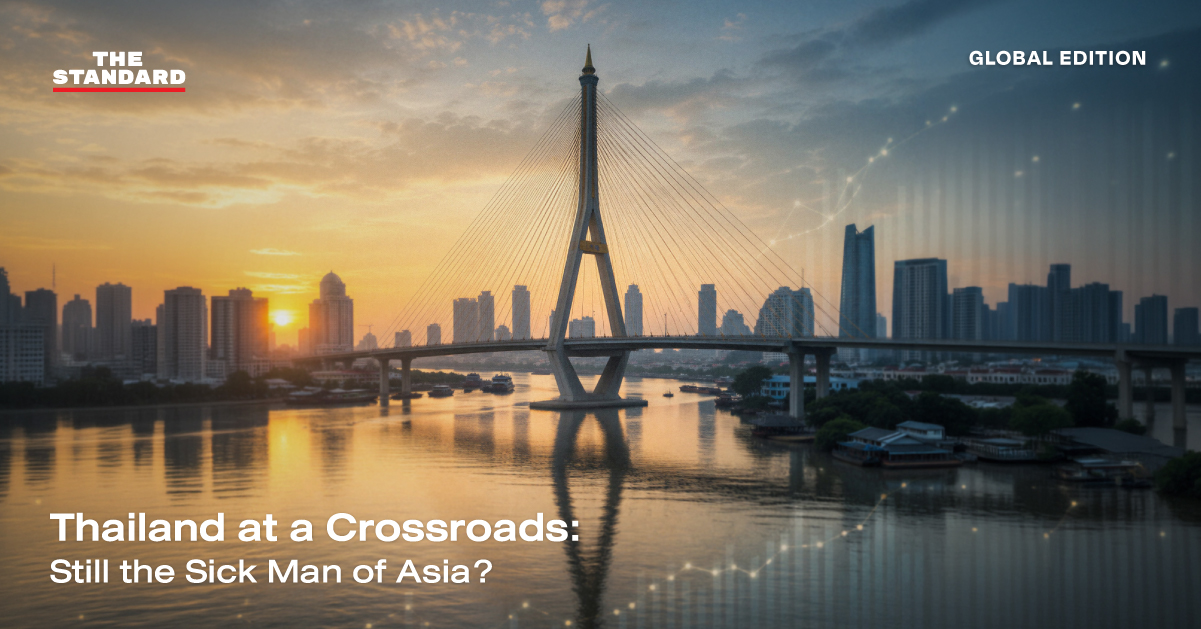
Follow Thailand’s trajectory over the past decade, and a clear pattern persists. There is a slow and steady structural decline, and whilst the 1997 financial crisis is now a distant memory, the gradual erosion of growth and competitiveness is also significant. All of a sudden, Thailand has been labelled as the ‘Sick Man of Asia’ by global outlets.
Whilst the country remained in cruise control, regional peers doubled down on infrastructure investment, poured resources into upskilling, and drafted new regulations to drive innovation. As a result of complacency, Thailand has fallen behind its neighbors.
Limited investment, productivity, and static infrastructure mean that Thailand has struggled to keep up with the demands of a highly competitive and rapidly changing world order. As modern economies integrate emerging technologies such as Artificial Intelligence, navigate new energy sources, and adapt to new supply chain realities, countries that are unable to adapt and thrive in the new world order will be left behind.
Thailand at a crossroads
In the past, Thailand’s policy debates have often revolved around toolkits, from raising the Debt Ceiling to the current topic surrounding the Emergency Borrowing Decree, but not enough weight has been given to why and what for. The issue is not simply whether the government should or should not borrow, as the current global context demands fiscal support, but rather how it will be used.
Whilst quick wins such as the government’s populist Kon La Krueng Plus co-payment policy may boost short-term consumer spending, it will have a limited impact on Thailand’s competitiveness.
The question brings us back to Thailand’s fundamentals and the need for structural reform. Borrowing for short-term stimulus packages with flattering quick-win metrics will only go so far.
Borrowing for meaningful transformation will produce long-term gains. Utilizing resources to upskill professionals and regain competitiveness, investing in renewables, and supercharging new growth engines are all worthwhile investments.
Meanwhile, Thailand’s MTFF (Medium-Term Fiscal Framework) is sending a clear signal that Thailand needs to increase government revenue. Although politically challenging, continuous investment will not happen without an increase in state income.
The Government’s New Playbook is a Balancing Act
Finance Minister Dr. Ekniti Nitithanprapas is tasked with balancing short-term gains with laying a solid foundation for economic growth. His ‘4T’ policy framework (Target, Transition, Transform, Together) is an encouraging sign of the Ministry’s commitment to long-term reform. Each pillar carries tangible policy commitments: attracting FDI into high-value sectors such as wellness, promoting new industries such as digital and renewables, investing in smart grids, and advancing the Direct PPA initiative, which would allow businesses to procure renewable energy independently.
The government is doubling down on green initiatives, with an upcoming pilot ‘old car for new car’ trade-in policy that incentivizes owners to swap aging vehicles for hybrids and EVs, advancing the energy transition and tackling the stubborn PM2.5 problem. If executed well, it could meaningfully accelerate EV adoption in Thailand. This policy isn’t just about swapping cars; it will serve as an early, tangible litmus test of whether the government is serious about ‘Walking The Talk’.
In an exclusive interview with The Standard, Dr. Ekniti outlined the government’s fiscal strategy and plans for capital deployment, which consist of both targeted relief measures and structural investment, drawing a disciplined line between short-term assistance and laying the grounds for long-term infrastructure building.
As Thailand continues to deal with the fallout of geopolitical conflict and its impact on energy prices, an emergency borrowing decree with a THB500 billion debt ceiling is being mulled. Separately, the Ministry has identified up to THB100 billion in the non-critical FY2026 budget that can be redirected to provide relief, meaning the government won’t be overstretched.
Following the rollout of the FY2027 budget, the government plans to allocate two sets of funds, with up to THB200 billion for short-term relief. Another THB200 billion will be allocated to structural transformation, focusing on solar infrastructure, EV charging networks, and fleet modernization.
Placing energy reform at the center of investments highlights how the government has recognized just how exposed Thailand’s energy dependency really is. This is an encouraging signal towards reform.
Building on that, State-owned enterprises are being considered to anchor investment in critical infrastructure, such as smart grids, as Thailand looks to accelerate its energy transition without burdening public finances. Infrastructure funds are being considered, a fiscally responsible move that could also attract private capital.
Thailand’s fiscal position is being pulled in several directions at once. Supporting fragile groups, funding long-term infrastructure, managing debt ceiling constraints, and moving ahead with structural reform are equally important. The 2026 GDP forecast from relevant agencies has been revised downward to 1.6%, highlighting just how necessary deliberate allocation is for our economy.
The Structural Struggle
Thailand’s need for Structural Reform sits at the heart of it all. Whether the country is equipped to move forward and compete in the new world order depends almost entirely on political will.
Meaningful change is not about stimulus measures or borrowing decrees; it’s rewriting the rules that have kept systems and the status quo firmly in place for decades. Such rules have given way to bureaucratic hurdles and complex regulations, creating loopholes for corruption and monopolies.
If Thailand does not pursue structural reform, the country will remain constrained by the same limitations.
Moody’s is not concerned with Thailand’s debt level, but places a spotlight on our country’s growth potential. Thailand may not be in crisis, but a change in rating is not indicative of recovery. The real question is not simply about GDP expansion, but whether we will have enough political will to dismantle the structures and rules that have long suppressed our competitiveness.
THE STANDARD Global Edition is produced in collaboration with Bitesize Bangkok.