




Thailand is trying to fast-track its way into the AI era with a 1.6 billion baht price tag.
Key point
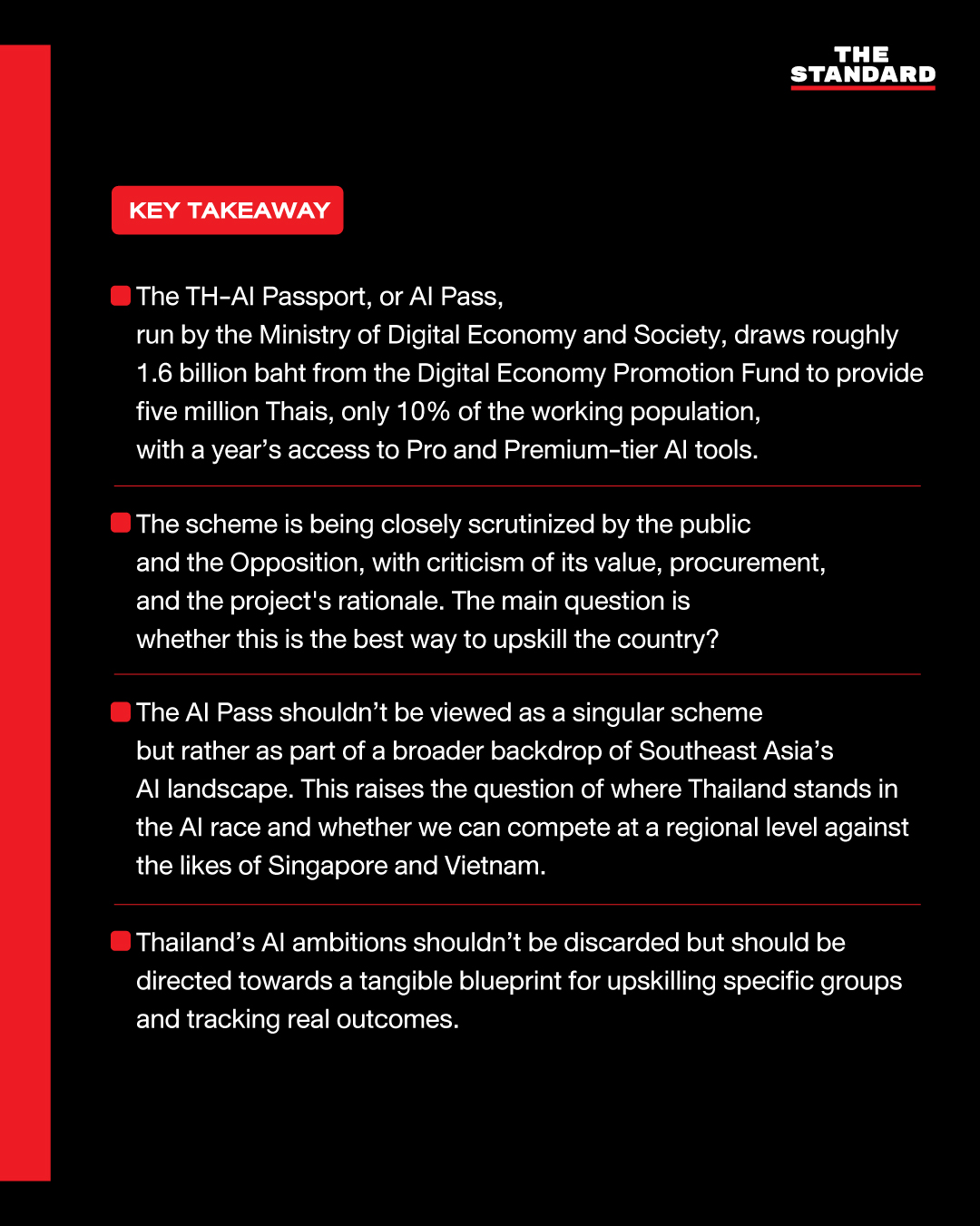
The TH-AI Passport, or AI Pass, run by the Ministry of Digital Economy and Society, draws roughly 1.6–1.62 billion baht from the Digital Economy Promotion Fund to provide five million Thais, only 10% of the working population, with a year’s access to Pro and Premium-tier AI tools. The scheme promises access to over 30 models from 14 providers, recognizable names such as ChatGPT, Claude, and Gemini, bundled alongside over 130 online learning courses.
The scheme seems logical on paper, as Thailand cannot afford to merely watch the AI revolution happen from the sidelines. For a country stuck in a middle-income trap, with a workforce of 40 million, an aging population, and chronically low productivity, leveraging AI could be a significant tool to uplift Thailand’s economic potential.
With that said, buying an expensive AI pass does not automatically pave the way for Thailand to become an AI economy.
From Access to Absorption
The controversy surrounding the TH-AI Pass isn’t necessarily about access, but about whether the state is deploying public money to build real, durable capabilities with a clear blueprint to upskill the population, or simply spending over a billion baht to purchase a one-year license to foreign technology without any clear technology or knowledge transfer. The key distinction between access and absorption is that the latter is the ability to convert the tools into tangible skills, courses with a real deployment plan for productivity gains.
Thailand often succeeds in access but struggles to meaningfully convert opportunities into long-term economic growth. The country is able to import technology, draw investment, and launch grand digital schemes, but often struggles to convert such inputs into domestic capability.
The AI Pass, therefore, serves as a mirror held up to reflect Thailand’s structural challenges, one that goes deeper than just tech giveaways.
A Big Project Demands a Bigger Question
Vocal criticism of the AI Pass doesn’t translate to criticism of AI itself. The reality is quite the opposite: there is a broad consensus that Thailand needs to accelerate its AI adoption and skill-set development. The criticism concerns the suitability of the scheme itself.
There are five legitimate concerns.
First, the all-too-familiar issue of procurement transparency. The public terms of reference (TOR) drew scrutiny for their feasibility, specifically whether registration can be successfully opened within 30 days with a 90-day delivery target.
Second, the scheme’s value for money. A quick calculation against the five-million-person target puts the cost at approximately 320 baht per person. The real question is whether this spending will actually translate into building long-term skills and improving public-sector efficiency on paper.
Third is the quality of AI on offer. There are valid concerns from field professionals that the ‘Pro-tier’ access specified in the project may fall short of commercial Pro subscriptions and may not differentiate much from existing free versions.
Fourth is the purpose of it all. What will Thailand have to show for this once the year is up and the country has already spent over a billion baht on acquiring an AI pass? If, ultimately, all Thailand has to show for it is a stack of expired user accounts, then it’s just another costly expenditure with far-reaching consequences.
Finally, the sensitive touchpoint of data security. In today’s world, data itself is an economic asset. If the government is unable to assure its citizens that their data won’t be shared or stored securely, enthusiasm and sign-ups for the scheme could fall short.
Thailand’s Position in the AI Race
The AI Pass shouldn’t be viewed as a singular scheme but rather as part of a broader backdrop of Southeast Asia’s AI landscape. The region is fast becoming a new battleground for AI, cloud, data centers, semiconductors, and digital infrastructure.
This raises the question of where Thailand stands in the AI race, and whether we’re able to compete at the regional level.
When placed alongside peers, Thailand’s weaknesses become more revealing. Singapore leans on its world-class governance, strong regulation, and talent. Meanwhile, Malaysia is carving out its own niche in the data center and semiconductor space. Vietnam is Thailand’s most direct competitor as a manufacturing base, but with a younger workforce and highly competitive costs, while Indonesia has the benefits of its vast population and rapid adoption of digital technologies.
Thailand actually has a deeply rooted manufacturing base compared to many of its peers, and a solid infrastructure with expertise in tourism. Thailand’s industries, from automotive manufacturing to healthcare and electronics, are all sectors with real potential for AI integration. However, the country struggles to translate potential into real capability; therefore, the conversation is often limited to what-ifs and calls for further reform.
Against Singapore, Thailand’s weaknesses are policy precision and regulatory efficiency. Against Vietnam, it’s the pace of upgrading the labor force; and against the world at large, Thailand’s disadvantage is its inability to convert access to technology into a meaningful engine for growth.
Lessons From FDI
The TH-AI Pass shares striking resemblances to Thailand’s long-running challenges with foreign direct investment (FDI). Thailand’s economy expanded 2.8% in Q1, largely driven by a 10% surge in private investment in machinery, capital goods, and factory construction. Simultaneously, BOI investment applications hit 1 trillion baht, with much of that capital concentrated across digital sectors.
The extent of capital shows that the country isn’t lacking in numbers, but we are at risk of becoming a high-value production base without any technology transfer. These businesses may build factories in Thailand, but we do not get to absorb the technology, the knowledge, or the R&D.
The real risk is that Thais gain temporary access without building lasting skills, data, or local AI ecosystems.
Mapping Thailand’s Priorities
Thailand should continue to pursue its AI ambitions, but with a more critical approach. Beyond costly procurements, the government has to showcase its commitment to upskilling the workforce, rather than making it just a conference buzzword.
AI literacy must become a widespread skill, evident across classrooms, training centers, and offices. Targeting groups and measuring outcomes must also be efficient; spending public money at this scale demands an outcome-based design. The government should focus on specific groups, from teachers to SMEs, in order to efficiently deploy resources, curriculum, and a trackable KPI. Following on from this, the success of an AI scheme should not be measured in sign-ups, but by economic value and productivity gains.
Beyond this, another critical element is public trust, because in this economy, trust is essentially infrastructure. The government has a responsibility to earn public trust in this regard.
Lastly, any national-level AI policy must be linked with the FDI policy, with BOI incentives tied to outcomes, such as leveraging local suppliers, upskilling Thai workers, and knowledge transfer
Beyond the AI Pass
Whilst we shouldn’t downplay the fact that the pass may be an initial entry point for Thais to experiment with AI, it’s important to differentiate between access and the capture of real opportunity through absorption.
Countries that leapfrog ahead in the AI era are those that use the technology to redesign local economies and to innovate across industries through technology adoption and workforce transformation.
Thailand needs to think beyond the five million sign-ups and consider what happens after committing 1.6 billion to a handful of AI platforms. Will the country ultimately build a more efficient economy and transition out of the middle-income gap? Will students be able to compete regionally, and will middle-aged workers be able to provide value in today’s landscape?
Access is merely a starting point. The ability to convert the technology into a real asset is Thailand’s real test for the ages.