


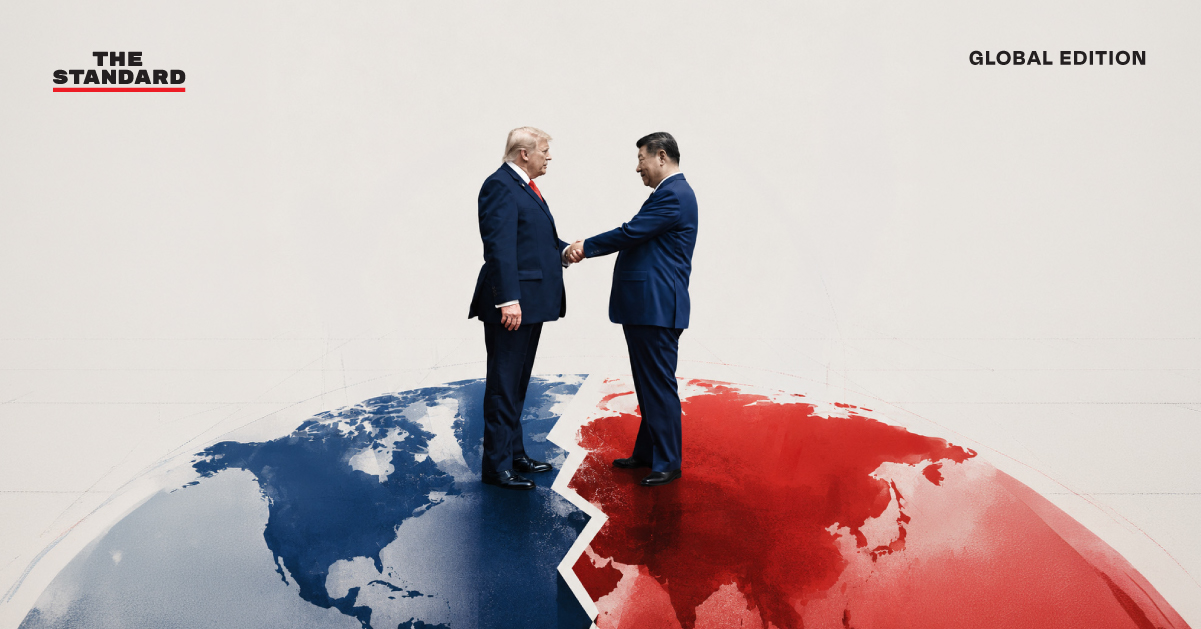
In a world where global superpowers such as the United States and China are negotiating on matters of national interest, Thailand finds itself having to defend its own credibility and transparency while paving its way to create strategic value. As geopolitical uncertainties take center stage, countries such as Thailand must defend their credibility for a place in the new world order.
Key point
- From Trump to Xi: Sandwiched Between Superpowers
- When CEOs Enter The Negotiating Table
- The New World Order: Globalization As We Know It Is Gone
- Thailand’s Test: Navigating Pressure From All Angles
- The Government is Sending Signals, but is it Enough?
- The Credibility Gap: Corruption As a Cost
- When Neutrality isn’t Enough
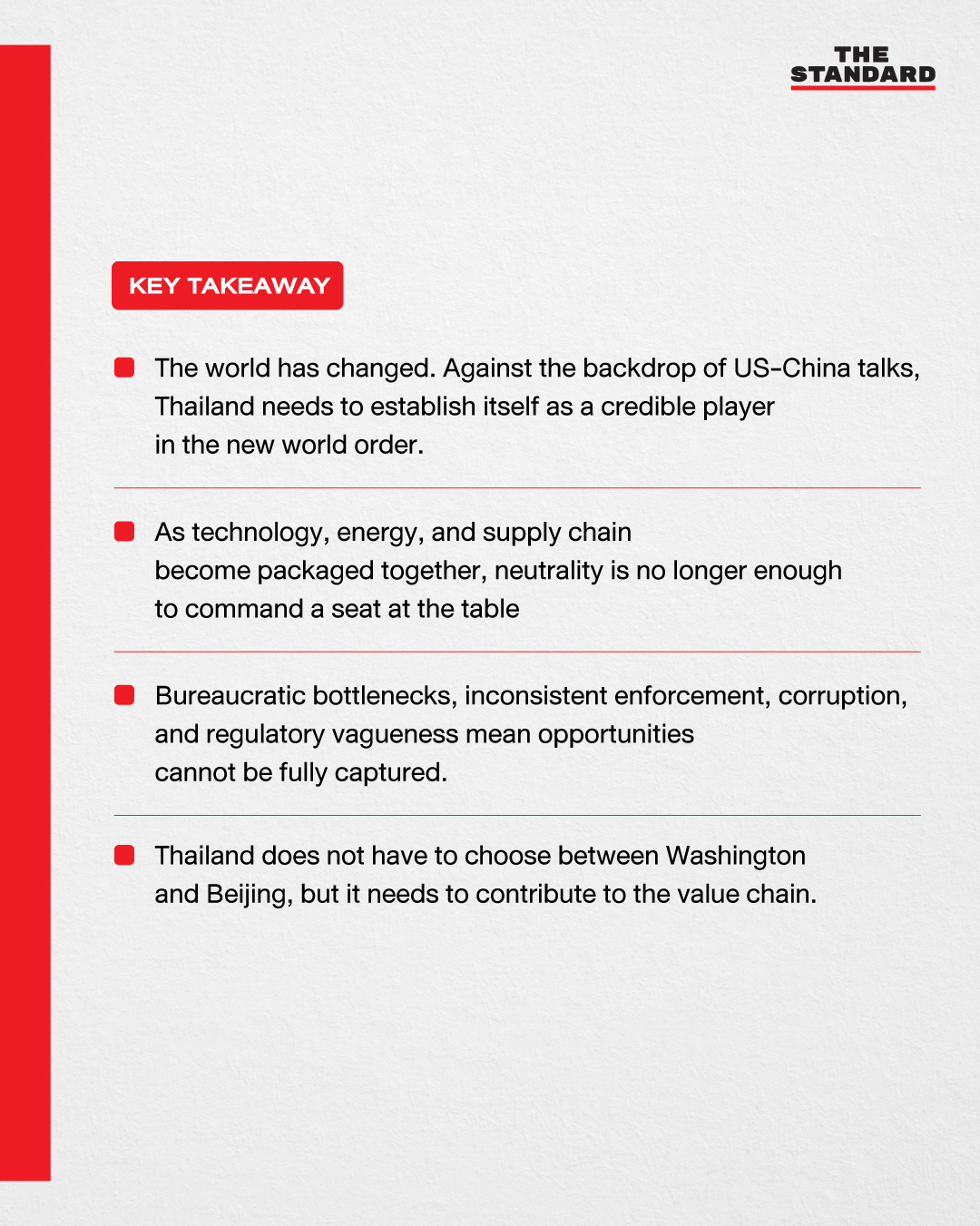
The meeting between President Trump and President Xi Jinping in Beijing goes beyond diplomatic and trade discussions, serving as a signal to Thailand. In an environment where trade, technology, and security are packaged together, neutrality and diplomatic goodwill are no longer enough to sustain a position.
Thailand may not have to choose sides between the two powers, but it will have to prove its credibility across the entire value chain.
From Trump to Xi: Sandwiched Between Superpowers
President Trump’s visit to China at President Xi Jinping’s invitation is geopolitical dealmaking at its best. Tariffs and trade aren’t the only issues on the table; the narrative also includes technology, AI chips, Asia’s stability, and implications for Taiwan. Discussions, therefore, transcend trade balances and center on the new world order.
The President has his agenda. There is a need to demonstrate to his voter base that engaging with China has tangible economic returns. Meanwhile, China needs to signal that it remains a vital market in which US corporations cannot bypass.
Thailand needs to pay attention. Discussions between the global powers can alter the course of the tariff structures, investment flows, and supply chain configurations. Countries without clear positioning, which face questions over governance risk being left out of the new global economy altogether.
When CEOs Enter The Negotiating Table
President Trump’s accompanying delegation to Beijing consisted of tech CEOs, a decision telling in itself. Over ten American business leaders from aviation, technology, finance, and strategic industries accompanied the President.
This sends a clear message. CEOs are no longer bystanders in geopolitics; they sit at the table. Private companies across areas such as AI and semiconductors are now direct actors in negotiations between key states. Businesses can now shape and influence geopolitics.
This carries implications for Thailand. If the state and private sectors of global powers are now acting in the same interests, then countries seeking to attract capital must have transparent systems to leverage such opportunities. Thailand must be able to generate value in return; there is no free lunch.
The New World Order: Globalization As We Know It Is Gone
The global discourse surrounding the “Decoupling” between the US and China took certain realities for granted. Truth is, the reality is much more complex.
The US wants to reduce its dependency on Chinese technology, namely, semiconductors and national security assets. China, in turn, aims to reduce its vulnerability to American export controls. Yet, both superpowers retain significant economic incentives to maintain the relationship, namely across consumer markets, investment flows, and financial services.
Therefore, globalization, as we understood it, is over. However, decoupling isn’t happening either. The term that best describes current economic realities is transactional rivalry.
Certain domains will remain contested amid increased competition, especially in advanced technology, security, and data. In other matters, the global powers will need to find common ground and balance shared interests; this will shift and change.
For Thailand, navigating this complexity won’t be easy, as the deals struck between the US and China can simultaneously create opportunities and pressure. It is no longer enough to thrive on neutrality, without demonstrating worth and capability at the table.
Thailand’s Test: Navigating Pressure From All Angles
Thailand is facing a critical challenge across multiple fronts, from trade to supply chains. As an export-reliant economy dependent on foreign direct investment, Thailand sits at the intersection of supply chains connecting the United States, China, Japan, Europe, and ASEAN. Historically, this was a strategic advantage. Now, it also makes Thailand vulnerable to exposure.
Trade data shows that Thailand is on Washington’s radar. In 2025, bilateral goods trade between Thailand and the United States reached $110.8 billion, with the US goods trade deficit with Thailand standing at $71.9 billion. This also means Washington is scrutinizing the country for trade imbalances. The United States is Thailand’s largest export market, accounting for approximately 18.3% of total Thai exports in 2024. The consequences of a faltering relationship would have long-lasting implications beyond a single export sector.
Thailand cannot risk being seen as merely a low-cost production base or a means to avoid tariffs. The country needs to meet the requirements of a productive, trusted partner in the new world order.
The Government is Sending Signals, but is it Enough?
The government is signaling awareness of the new world order, from its discussions with the Office of the United States Trade Representative (USTR), to creating more ease in doing business for certain foreign-owned entities.
The Cabinet has approved in principle an amendment to the rules under the Foreign Business Act. However, oversight remains with relevant governing bodies such as the NBTC and the Bank of Thailand.
Removing bureaucratic steps is necessary for Thailand to compete with its regional peers for high-quality business. However, lowering the barrier of entry alone is not the solution. The question remains whether Thailand’s regulatory framework is robust enough to ensure fair and transparent competition, and whether the state can navigate politics such as nominee arrangements and monopolistic agreements.
Investment in the first quarter of 2026 reached 260 billion baht, up 18%. Thailand has pockets of opportunities, with the potential to capture new growth engines. However, opportunity does not equate to results.
Timely licenses and enforced regulations are crucial to investor confidence, and this is what Thailand needs to deliver on.
The Credibility Gap: Corruption As a Cost
Thailand’s biggest weakness is the inability to turn opportunities into tangible outcomes. A survey by the Joint Standing Committee on Commerce, Industry and Banking found that 89.1% of respondents identified corruption as an obstacle to doing business.
Corruption directly erodes Thailand’s competitiveness and indirectly raises the cost of conducting business here, whilst also impacting markets and investor confidence. The picture is consistent with Thailand’s standing in the 2025 Corruption Perceptions Index, where the country scored 33 out of 100.
There is not enough incentive or subsidy that can overshadow this reality.
When Neutrality isn’t Enough
Amid a fast-changing world order and complex geopolitical ties, Thailand needs to commit to becoming the nation it aspires to be. The country does not need to pick between Washington and Beijing, but it needs to lay the groundwork for productivity and contribute meaningfully to the supply chain.
Beyond being an affordable production base, Thailand needs to be a reliable destination for countries to conduct business, rather than relying on quick wins and shortcuts.
The real risk is that Thailand remains constrained by domestic limitations, such as corruption and its own bureaucracy, in capturing wins in today’s new world order. Neutrality may not be enough to maintain Thailand’s relevance, especially with the absence of credibility.
Thailand needs to prove it can navigate the challenging waters of contemporary geopolitics and rise to the demands of a new world order through a series of meaningful reforms.