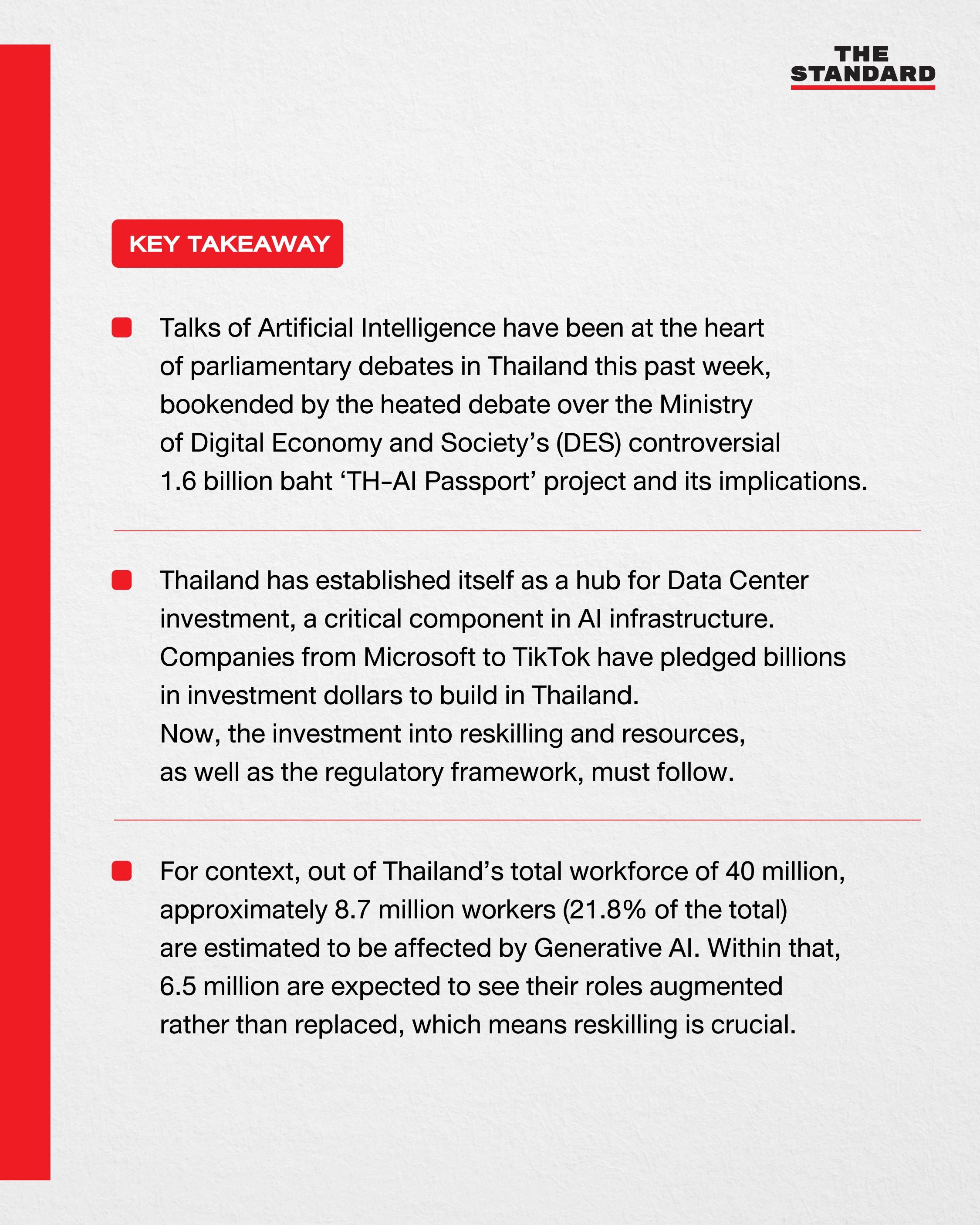







Talks of Artificial Intelligence have been at the heart of parliamentary debates in Thailand this past week, bookended by the heated debate over the Ministry of Digital Economy and Society’s (DES) controversial 1.6 billion baht ‘TH-AI Passport’ project and its implications.
Key Point
The country has arrived at a critical inflection point. The world is not patient when it comes to rapid AI adoption and skills acceleration. There are viable figures to support this: Out of Thailand’s total workforce of 40 million, approximately 8.7 million workers (21.8% of the total) are estimated to be affected by Generative AI.
The timing of current debates is significant. In the same quarter that Thailand recorded billions of dollars in AI-related investment applications, its largest BOI figure in recent memory, the government’s flagship program is under scrutiny.
Amid a race to reskill a nation saddled with an economic slowdown, high household debt, and a rapidly aging population with a low birthrate, governance also needs to keep pace. The gap between intention and governance lies in everything that matters about where Thailand actually stands amid the creation of a new global AI order.
Thailand as a Data Center Hub: Infrastructure is Arriving
According to the Thailand Board of Investment (BOI), Q1 2026 investment data was led by the Digital and Electronics sectors, riding the AI wave. Digital initiatives amounted to 873,741 million baht (US$27.3 billion) across 48 projects spanning data centers and cloud services. Names include TikTok and Skyline Data Center & Cloud Services.
Thailand is positioning itself as a Data Center hub, drawing billions of dollars worth of investment from global companies. Amazon has committed $5 billion over fifteen years, TikTok $8.8 billion over five, and Microsoft $1 billion over two, a cascade of big-tech capital arriving in Thailand at different speeds.
BOI incentives for data centers typically include corporate tax exemptions, import duty relief on equipment, and facilitation of foreign ownership and land use. What the country should see more of are criterias such as technology transfer requirements and long-term R&D commitments.
The investment landscape is shifting away from the asset-light era, such as software companies, towards HALO (Heavy Asset, Low Obsolescence), a fledgling physical infrastructure that AI itself cannot replace.
Billions of dollars in investment capital are positive for Thailand, and the country gains physical infrastructure on its soil that serves its own population. However, hosting infrastructure is not the same as owning or leveraging the value these centers will create. Thailand will need to ensure that its workforce governance keeps pace with its regional ambitions.
The government’s argument is that data centers attract a thriving ecosystem, from cloud-dependent startups to regional tech hubs, but this success requires many other conditions: a talent pipeline, a supportive regulatory environment, and startup capital, all of which remain a work in progress.
The Hidden Cost of Data Centers: A Call For Reform
The stability of the electrical system is the most critical factor for data centers, as they rely on a continuous power supply. Thailand’s electricity demand for data centers is forecast to reach 6 TWh by 2030, representing 2.5% of total power consumption.
The billions of dollars in demand are well and good, but Thailand needs to be realistic about energy delivery. Data center development has been heavily concentrated in the EEC across Chonburi, Rayong, and Chachoengsao, but the energy infrastructure serving that corridor was designed for conventional industrial loads, making it challenging to accommodate the power demands of hyperscale campuses that run 24/7.
The data center boom is actually forcing an energy reform that Thailand already needs to consider. These investments are creating a real political incentive to accelerate the use of renewable energy and Small Modular Reactors (SMRs), which are ideal for power generation in demanding facilities.
Thailand has the geographical advantages and a relatively stable grid to build on. But a thriving AI ecosystem runs on vast physical infrastructure, and that infrastructure still needs to be built.
Without this transition, Thailand’s AI target will remain as lofty ambitions. Without the grid, the policy framework, and the technology transfer to match, Thailand risks becoming a high-value landlord collecting rent on infrastructure it doesn’t control.
Thailand Is Betting Big on AI, But The Work Force Needs to Catch Up
Findings from the National Economic and Social Development Council (NESDC) show that Generative AI is affecting more than 8.7 million Thai workers, with 6.5 million expected to see their roles augmented rather than replaced, as AI is expected to handle the systematic parts of their jobs.
Beyond this, the labor market faces a further disruption on the horizon with the emergence of Physical AI, the merging of AI with automation, poised to reshape employment across manufacturing, logistics, and services in the next wave.
These forecasts should serve as a critical incentive for the state to upskill and reskill the Thai workforce. Beyond being buzzwords, the two terms offer a meaningful way for workers to coexist with technology during the next wave of disruption.
The government is taking notice, but not urgently enough. The National AI Action Plan (2022–2027) under the ‘MHESI for AI’ policy sets a target of producing 30,000 AI-skilled workers within three years, spanning researchers and developers, applied engineers, and general professional users. However, Thailand’s real challenge isn’t the blueprint on paper but the execution gap between policy ambition and the pace of technological change. Upskilling needs to happen fast enough to transition workers from operators to AI managers, and the scale needs to be more ambitious than targeting fewer than 1% of the total affected workforce.
The 1.6 Billion Baht Question
The state also needs to adapt quickly to AI, with bureaucratic bottlenecks and paper-intensive processes a significant obstacle to conducting business in Thailand. The Office of the Civil Service Commission (OCSC) has approved a framework of seven digital skills for government personnel, aimed at preparing public sector workers for the AI era and to deploy AI for repetitive administrative tasks to boost productivity.
The intention is there, but state-centric initiatives need a clear roadmap and trackable KPI.
The government’s flagship AI push is currently not without controversy. Under the Ministry of Digital Economy and Society (MDES), the 1.6 billion baht Thailand AI Passport project aims to give citizens access to AI tools and platforms, but it is now under reconsideration following intense scrutiny over transparency concerns and allegations that its TOR was structured to benefit specific business groups.
IMC Institute director Dr. Thanachart Numnonda told THE STANDARD WEALTH that much of what the TOR specifies is already available for free, and risks being obsolete before it launches. The 1.6 billion baht would be better spent on training people to use existing tools and on sector-specific AI implementation.
There are regional examples to draw from. Singapore rolled out a national initiative in which citizens who enroll in selected SkillsFuture AI training courses receive 6 months of free access to premium AI tools in order to boost national workforce capabilities. The nation also launched a multi-year partnership with OpenAI to expand deployment and build local talent, but Thailand is unable to pursue this due to legal constraints.
Through a wider lens, the TH-AI Passport controversy is more about bureaucracy and procurement than boosting capability. The government has framed AI as a national priority, but the issue at hand becomes merely another government contract, once again missing the opportunity for meaningful change.
Whilst parliamentary debate drags on and the budget is on pause, Thailand risks falling behind and missing the window altogether.
The Reality at Stake
Thailand has arrived at this crossroads before. Foreign capital arrives, a global technology shift creates a window, and the policy response gets consumed by familiar processes, procurement disputes, and the slow bureaucratic drag that delays it all.
There is significant demand from global players such as Microsoft, TikTok, and Amazon, and a BOI pipeline that highlights billions being poured into the economy. Thailand’s strategic assets, from the country’s geographical position to grid stability, have value.
Behind the infrastructure demand lies various contradictions. The country needs to follow through on energy deliverables to meet demand, and a workforce of millions needs to be meaningfully trained and upskilled, or risk becoming obsolete amid a challenging technological shift that waits for no one.
With the workforce transition program addressing less than 1% of the working population, and the government’s most visible AI initiative under scrutiny for corruption, Thailand needs to devise a clear roadmap to stay on track with its ambitions.
THE STANDARD Global Edition is produced in collaboration with Bitesize Bangkok.