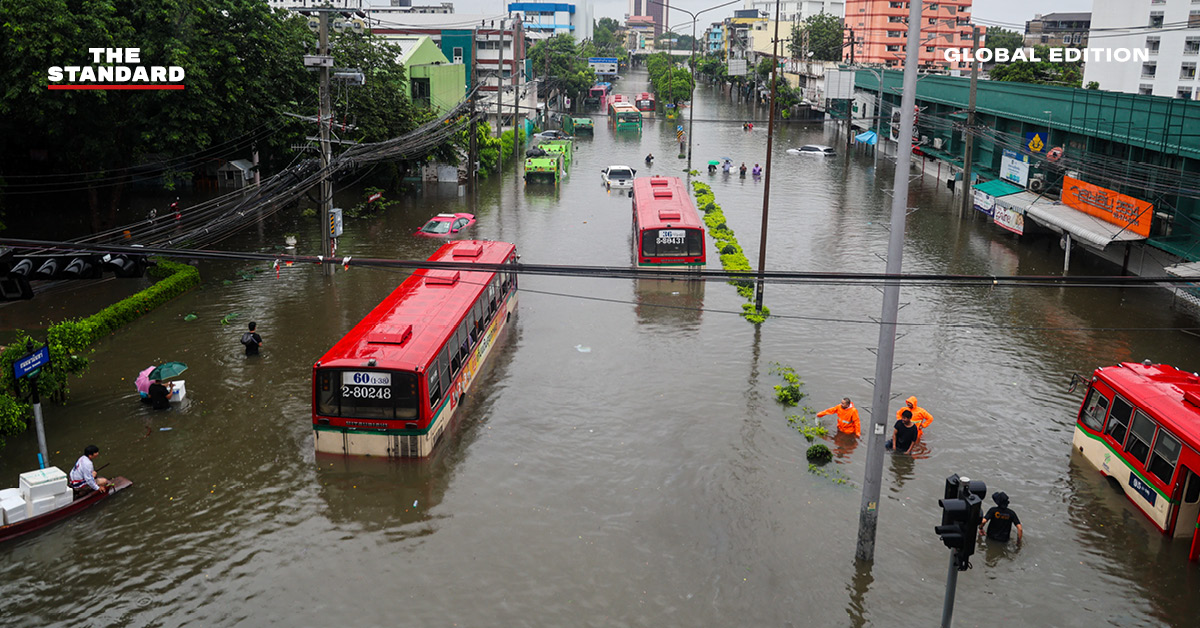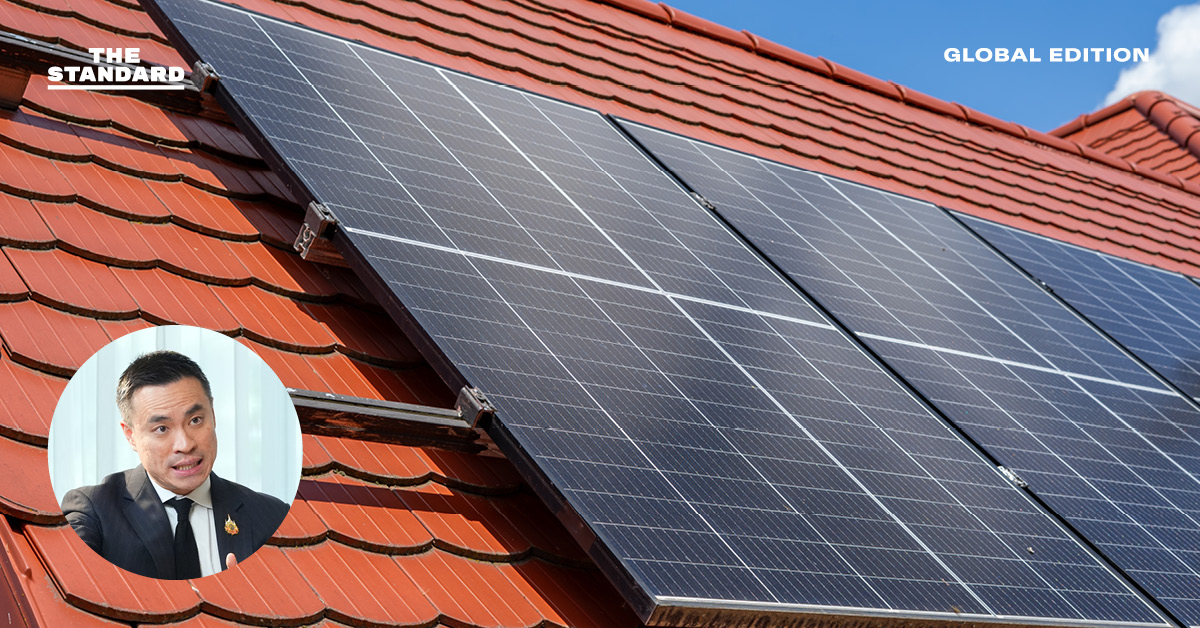

On 26 August 2026, parliament approved the government’s THB 400 billion baht emergency loan decree, thereby putting in motion the mega plan to reform Thailand’s energy landscape, clean energy investment, power grid infrastructure and to support those affected by the current crisis through shorter-term measures.
Key Point
- FY2027 Budget Debate Exposes Deep Structural Cracks in Thai Fiscal Policy
- The Government’s Defense: Operating on Existing Wounds
- Stubborn Wounds: Recurrent Spending Hits 73.6% of the Budget
- Thai Personnel Spending Hits 37.9% of Budget, Reflecting High Opportunity Cost Versus Peers
- Suggestions From Experts: How to Tackle Thailand’s Bureaucracy
- The Key Issue at Hand: Government Revenue Growth Lags Spending
- Thailand’s Public Debt: Risks Still ‘Hidden’ Beneath the Surface
- FY2027’s Live Broadcast Raises More Questions Than It Answers
The latest move brings Thailand’s fiscal health to light, revealing cracks in the details. The emergency loan decree is merely a symptom of a much larger structural problem.
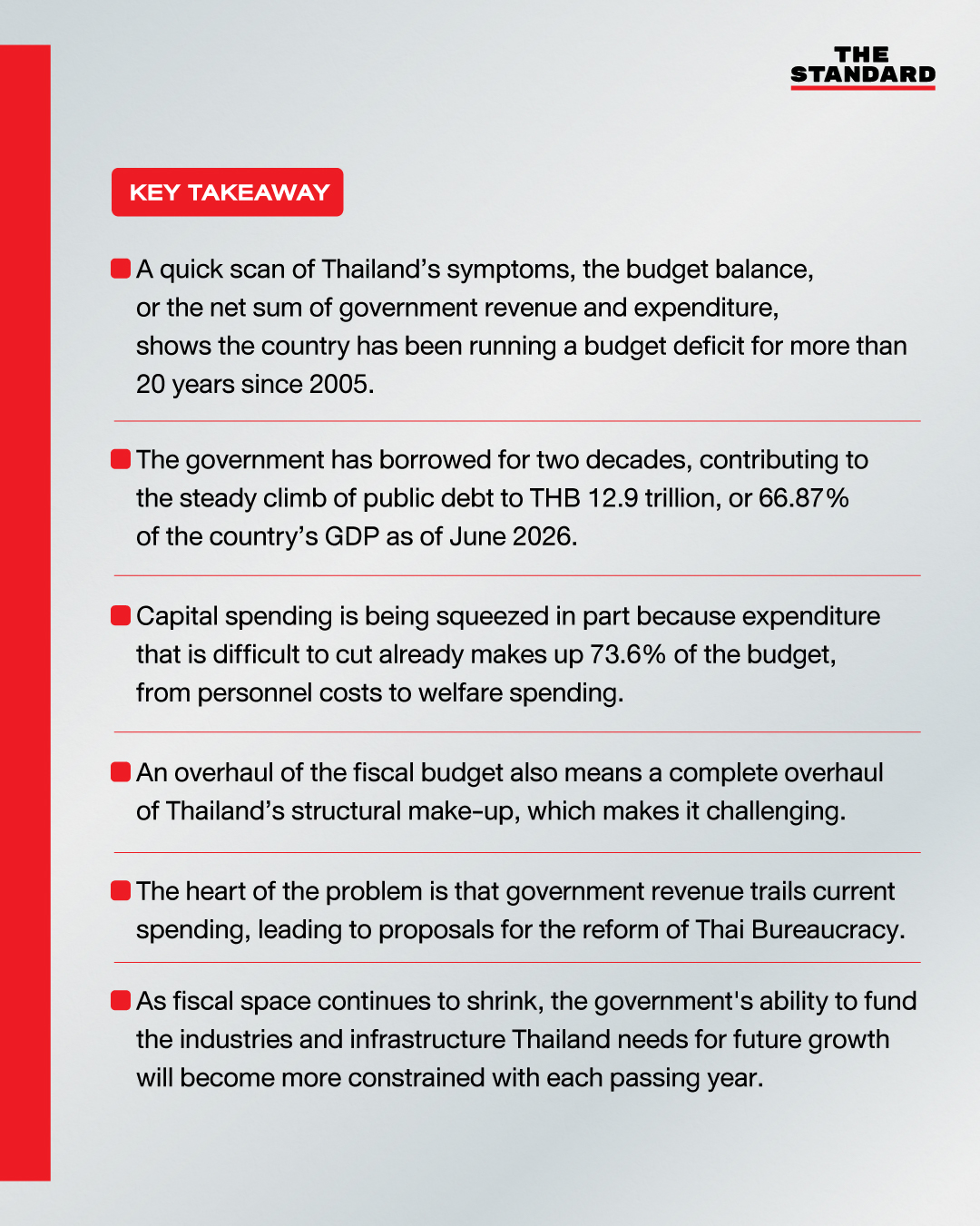
A quick scan of Thailand’s symptoms, the budget balance, or the net sum of government revenue and expenditure, shows the country has simply been spending more than its earnings, running a budget deficit for more than 20 years since 2005.
This has contributed to the steady climb of public debt to THB 12.9 trillion, or 66.87% of the country’s GDP as of June 2026.
The fiscal 2027 budget framework sets total expenditure at THB 3.788 trillion against projected net revenue of THB 3 trillion, which means the government will need to borrow another THB 788 billion to cover the shortfall.
The draft 2027 budget bill confirms the country is preparing to run a deficit for yet another year. Capital expenditure, the spending that actually drives economic growth, is set to fall 8.4% from the previous year, even as recurrent expenditure rises 5%.
This poses the critical question of how much fiscal space Thailand has left for future investment, as debt and recurrent spending rise against the backdrop of declining capital expenditure. Fiscal space is what determines whether Thailand has the capacity to invest in growth, a vehicle which is necessary to remain competitive.
With the House of Representatives set to consider the FY2027 budget’s second and third readings on 7-9 September 2026, it’s critical to understand what’s fully at stake for Thailand, as shrinking capital expenditure and mounting debt collide with a narrowing window to change course.
FY2027 Budget Debate Exposes Deep Structural Cracks in Thai Fiscal Policy
Sirikanya Tansakun, deputy leader of the People’s Party and a vocal critic of the government’s fiscal management, argued that the structure of the 2027 budget reflects a chronic fiscal ailment, likening it to a ‘burst abscess.’
While the overall budget grew by just 7.4 billion baht, with projected revenue at 3 trillion baht, Sirikanya pointed out that the government still must borrow to cover the deficit. A budget shortfall exceeding 3% of GDP has become the new normal, a sign that state revenue is failing to keep pace with rising expenditure.
Over 70% of budget-receiving departments saw their allocations shrink compared with fiscal 2026, with the cuts concentrated among agencies that hold large shares of capital spending.
This imbalance underscores a structural tension at the heart of Thai fiscal policy: shrinking room for investment even as day-to-day government costs keep rising. Without a shift in priorities, the budget risks reinforcing short-term stability at the expense of long-term growth.
The Government’s Defense: Operating on Existing Wounds
Dr. Ekniti defended the FY2027 budget’s shift toward recurrent spending, saying his order to end the Bureau of the Budget’s practice of deliberately underfunding agencies, which had relied on treasury reserves to cover shortfalls repaid later, brought previously hidden costs into the open. This pushed recurrent expenditure up and forced a 70-billion-baht cut to capital spending.
“The abscess hasn’t burst,” says Dr. Ekniti. “We’re just opening the wound so we can treat it properly with transparency. I’m here to operate on the disease.”
Transparency is welcomed, but the important question isn’t even the size of the deficit, but whether the government can create, or even expand, the fiscal room Thailand needs to invest in its own future growth. So far, the government’s reform blueprint offers little clarity on how that fiscal room will actually materialize.
Stubborn Wounds: Recurrent Spending Hits 73.6% of the Budget
Thakoon Chulintorn, Director of the Parliamentary Budget Office (PBO), told an academic seminar analyzing the draft FY2027 Budget Expenditure Act that capital expenditure, set at THB789 billion baht, accounts for just 20.8% of the total budget.
Capital spending is being squeezed in part because expenditure that is difficult to cut already makes up 73.6% of the budget, comprising:
- Personnel costs: 39.5%
- Social welfare spending: 15%
Thai Personnel Spending Hits 37.9% of Budget, Reflecting High Opportunity Cost Versus Peers
A closer look at the numbers reveals a troubling picture for government personnel spending. Assoc. Prof. Athiphat Muthitacharoen of Chulalongkorn University’s Faculty of Economics said personnel expenditure in the draft FY2027 budget exceeds THB 800 billion, accounting for 37.9% of the total budget.
By comparison, the Philippines, a country at a similar development level, spends 35% and Malaysia 29.6%, while the average forupper-middle-income countries is just 20.9%.
Athiphat added that spending on government personnel benefits has nearly doubled, up almost 90% to nearly 600 billion baht in 2027, despite the relatively flat size of the civil service workforce.
The rise indicates that per-capita personnel spending has risen by an average of 5% annually, suggesting that the root of the problem may be the rising cost per employee.
Suggestions From Experts: How to Tackle Thailand’s Bureaucracy
Deputy Prime Minister for Legal Affairs, Pakorn Nilprapunt has laid out a four-pronged reform agenda to ease Thailand’s fiscal burden: a hiring freeze and an early retirement scheme offering lump-sum payouts of 8 to 12 times monthly salary; overhauling local government pay structures to close inequities and introducing “Better Regulation for a Better Life,” which would deploy AI to speed up administrative work and curb the ministerial discretion that fuels bribery.
Assoc. Prof. Athiphat Muthitacharoen of Chulalongkorn University recommends a “mission audit” first, to determine which functions are essential, which can be outsourced, and which AI can now handle, before restructuring ministries.
Piangphanor Boonklam, adviser to the Leader of the Opposition, argued the government should scale back to a “facilitator” role, withdrawing from competitive markets like telecommunications to focus on core services such as education and healthcare.
Patricia Mongkhonvanit, Director-General of the Comptroller General’s Department, framed the debate as “right-sizing” rather than downsizing, warning that personnel data scattered across independent agencies and local governments leaves no one with a full picture of government staffing or spending.
The Key Issue at Hand: Government Revenue Growth Lags Spending
In its analysis of the draft FY2027 Budget Expenditure Act, the Parliamentary Budget Office (PBO) highlighted structural risks in Thailand’s revenue base. Government revenue is heavily concentrated in three main taxes, which together account for 62.14% of total collection: value-added tax, corporate income tax, and personal income tax.
All three are closely tied to GDP, which means revenue contracts sharply whenever the economy slows.
Therefore, the government needs a complete overhaul of its revenue structure, including broadening the tax base, closing loopholes, reviewing exemptions, and improving collection efficiency to strengthen its fiscal position.
Thailand’s Public Debt: Risks Still ‘Hidden’ Beneath the Surface
Thailand’s public debt currently remains within the legal ceiling of 70% of GDP, standing at 66.87% as of June 30, 2026. Dr. Ekniti has repeatedly pledged to maintain fiscal discipline and keep debt below the ceiling over the medium term.
However, a PBO study projecting public debt over a five-year horizon found that under the baseline scenario, the debt-to-GDP ratio is set to reach 70.20% in 2028, fueled by the primary budget deficit and the emergency borrowing decree.
FY2027’s Live Broadcast Raises More Questions Than It Answers
For the first time, the Extraordinary Committee reviewing the FY2027 Budget Expenditure Bill opened its deliberations to live public broadcast, exposing several troubling issues in government spending, such as irregularities in the Fund for Rehabilitation and Development of Farmers’ financial statements.
The committee also scrutinized the government’s centralized cloud system, after the Office of the National Digital Economy and Society Commission’s budget rose 92%, with nearly 5 billion baht earmarked for a unified cloud project. Lawmakers found ministries were still procuring separate cloud services in parallel.
Beyond discrepancies and a lack of discipline across several areas of government spending, the hearings raised a deeper concern: capacity. As fiscal space continues to shrink, the government’s ability to fund the industries and infrastructure Thailand needs for future growth will become more constrained with each passing year.
THE STANDARD Global Edition is produced in collaboration with Bitesize Bangkok