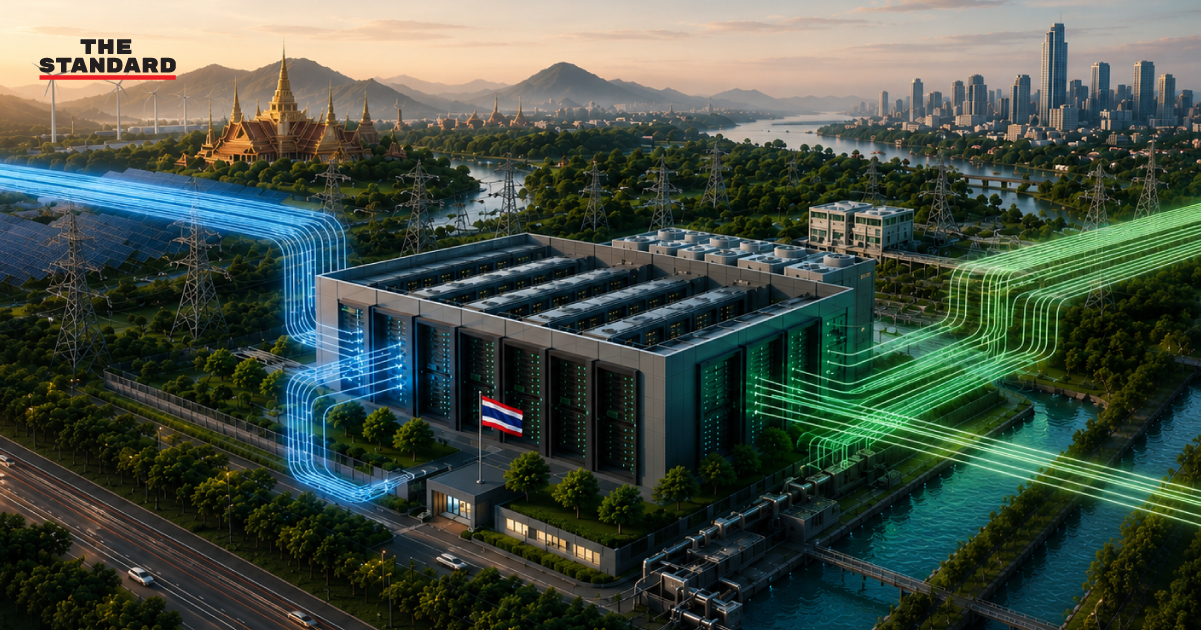
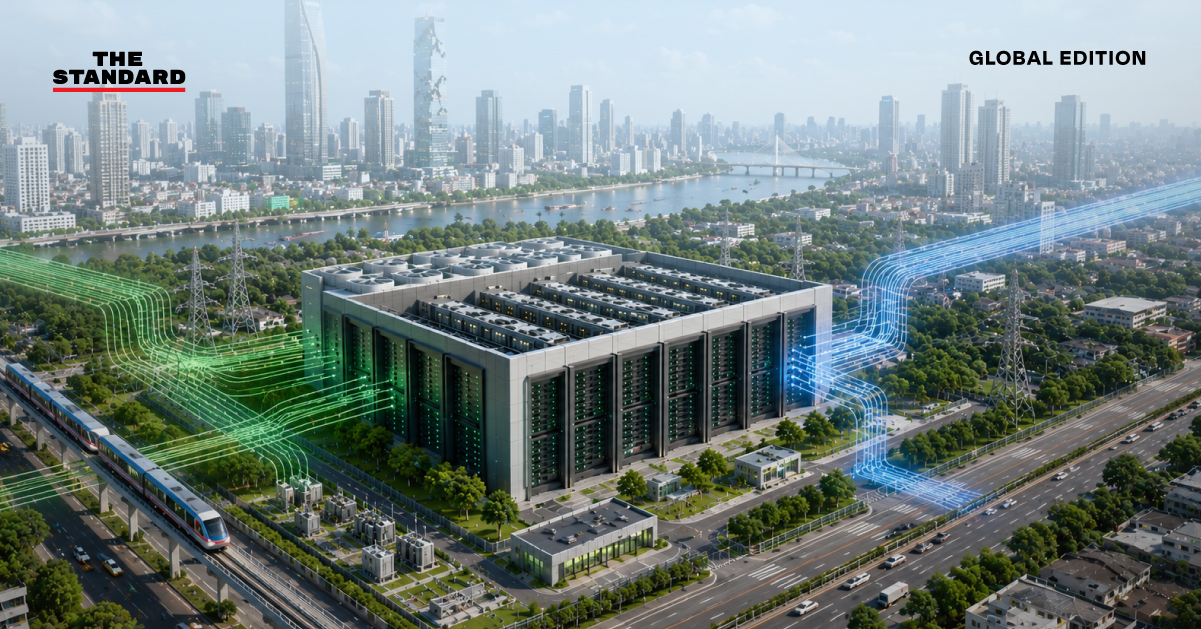
Thailand is in the middle of one of its most significant infrastructure booms in recent history, racing against itself and its regional peers to capture high-value tech investment before the AI window closes.
Key Point
We covered data centers extensively in last week’s Global Edition, highlighting how Thai regulation is scrambling to keep pace with the sector’s rapid growth through the newly established Data Center Policy Committee, tasked with governing the trillion-baht industry.
Fast forward to one week, and it appears that perhaps regulation isn’t moving fast enough. This week, questions about data centers appearing across Bangkok’s highly urbanized zones and seemingly outside of the government’s official records spread across news outlets and headlines. This awareness escalated fast, moving from an opposition MP’s social media post to an investigation by Bangkok Governor Chadchart Sittipunt within a day.
The rapid growth of data centers in the city raises not just necessary questions about resource strain, but also about the effectiveness of Thailand’s regulations, and whether they’re keeping pace with the level of innovation the country hopes to see.
When Legal Loopholes Crack
The controversy emerged when Suphanat Minchaiynunt, an MP from the opposition People’s Party, posted on his public Facebook page about whether the public was aware of unregulated Data Centers being built across Bangkok and other provinces.
This soon led to the discovery of a Data Center facility in the residential area of Ramkhamhaeng Soi 28, where Suphanat says was storing almost 500,000 litres of fuel, intended for use as backup power for its generators and surpassing the legal limit of about 200,000 litres.
Meanwhile, another facility near Rama IX Hospital spans 19,000sqm, legally defined as a high-rise building for warehouse use, electronic storage center and offices without the permit to store fuel. Following an investigation, the Department of Energy Business is now planning to file a police complaint over the reported unlicensed storage of over 200,000 litres of diesel.
This recent noise has prompted promise of careful reviews, with proposals set to be discussed with the Data Centre Business Policy Committee regarding zoning criterias and resource management.
The heart of this growing problem is because Thailand currently lacks the laws and legal framework to explicitly categorize Data Centers as such. Developers can register as warehouses, thereby bypassing the necessary environmental impact assessments.
It remains to be seen whether this will become another headline that gets buried after the attention span shifts somewhere else. However, it’s clear that regulations and good governance is needed to meaningfully capture the future-industry opportunities.
Zooming out: It’s Not Just a ‘Bangkok Problem’
Bangkok Governor Chadchart Sittipunt acted quickly and on Wednesday 2nd September, held a press conference to announce that the administration has suspended three applications for large, standalone data centers as concerns grew over fuel storage and pollution near heavily populated communities.
There are approximately 30-40 Data Centers in Bangkok alone, the majority existing inside company buildings and thereby covered by ordinary building permits. The Governor points to ‘legal loopholes’ as the main factor to why developers have been able to register the centers as warehouses or other facilities, leveraging the lack of clarity to remain operating at scale.
Whilst suspending three pending applications is well and good, it’s unlikely to affect the existing Centers that remain in operation. Thailand has 42 centers that are operating commercially, and has received 36 applications for additional centers and cloud-service projects. According to reports, more than half of these investments are allocated towards imported tech equipment, which means that the return in value for Thai businesses remain limited and concentrated in construction and land.
The Data Center issue at hand isn’t simply a Bangkok issue, but a national controversy in which Minister of Digital Economy and Society, Chaichanok Chidchorb himself confirmed that many centers in the capital were built without permission. According to reports, authorities are currently investigating matters such as fuel stockpiling and foreign investments across different facilities.
The most pressing question in the room is how this oversight was able to slide through the cracks and exist in plain sight across the capital.
The Larger Problem at Hand
The ‘unauthorized’ centers reveal a lot about the government’s capacity to govern industries it is simultaneously racing to attract. Zoom out, and it reflects a certain Thainess to the issue at hand. We have seen and heard about this level of regulatory mishap before, sprayed across varying sectors of the economy.
There is a true structural mismatch between Thailand’s investment promotion rhetoric and the Board of Investment (BOI)’s attractive headlines of investment metrics, with the country’s regulatory body. Whilst investment promotion is designed to move quickly, environmental and land-use regulation has failed to catch up despite the establishment of overseeing bodies.
The government is understandably excited about the prospects of attracting Data Center investments, as it allows us to be involved and tapped into the global AI supply chain boom, but as innovation in Thailand typically goes, the important details often get lost within the rhetoric and blueprint.
This kind of oversight is not unique to Data Centers. Incentives typically come first, and enforcement appears after public controversy. This narrative has played out across many large scale initiatives in Thailand, from the country’s EV push to financial technology.
Each public outcry for accountability is typically followed by promises of a ‘thorough review’ and ‘investigations,’ but without a clear framework of rules and regulations to follow. Fixes in this regard come off as more reactive to public sentiment more than a careful review of emerging industries.
Beyond the challenge of regulatory framework, regulators must also find a way to insert Thai businesses into the value chain, by allowing domestic firms to capture the growing opportunity at hand. It’s worth outlining how local companies can contribute, whether local parts can be leveraged and how technology can be transferred to the economy as opposed to simply providing real estate space.
As Thailand prepares to attract capital and commitment from foreign entities to fuel its ambitions of becoming a higher-income country by 2037 through upskilling workers and capturing high-growth industries, this oversight in Data Center governance will carry a cost through many sectors. To appear investment-ready, Thailand must ensure that regulations, rules and enforcement keep up with its ambitions, or lose credibility all together.
Key Takeaway
Thailand’s rapid expansion of Data Centers and the recent controversy expose a deep structural flaw in how the country operates. Whilst we have seen variations of this regulatory shortcoming before, it highlights the importance of governance and effective legal framework, especially as Thailand is set on capturing high-growth, high-value industries in competitive sectors. This goes beyond Data Centers, and should be applied to every emerging industry Thailand plans to court to realize its high-income ambitions.
THE STANDARD Global Edition is produced in collaboration with Bitesize Bangkok