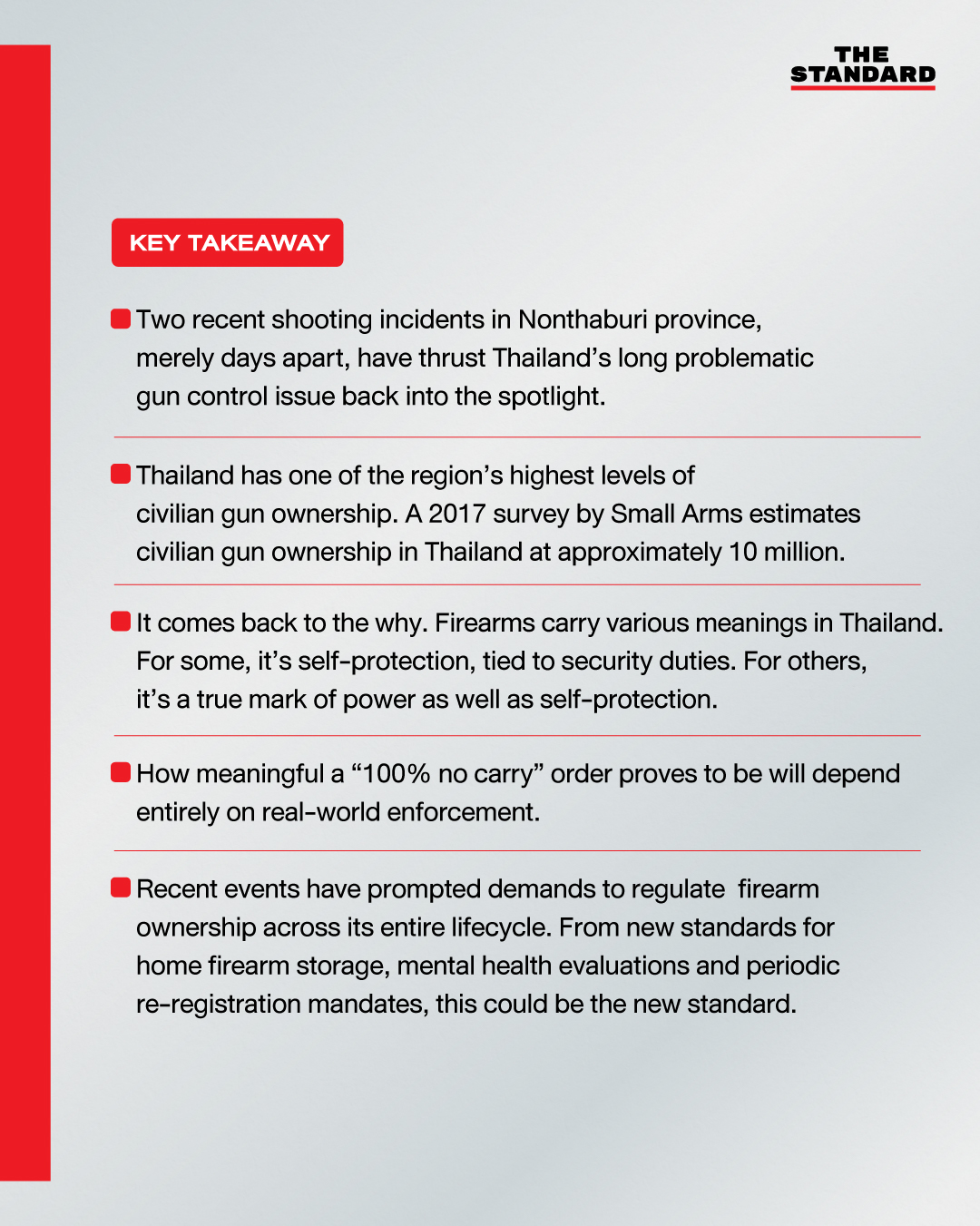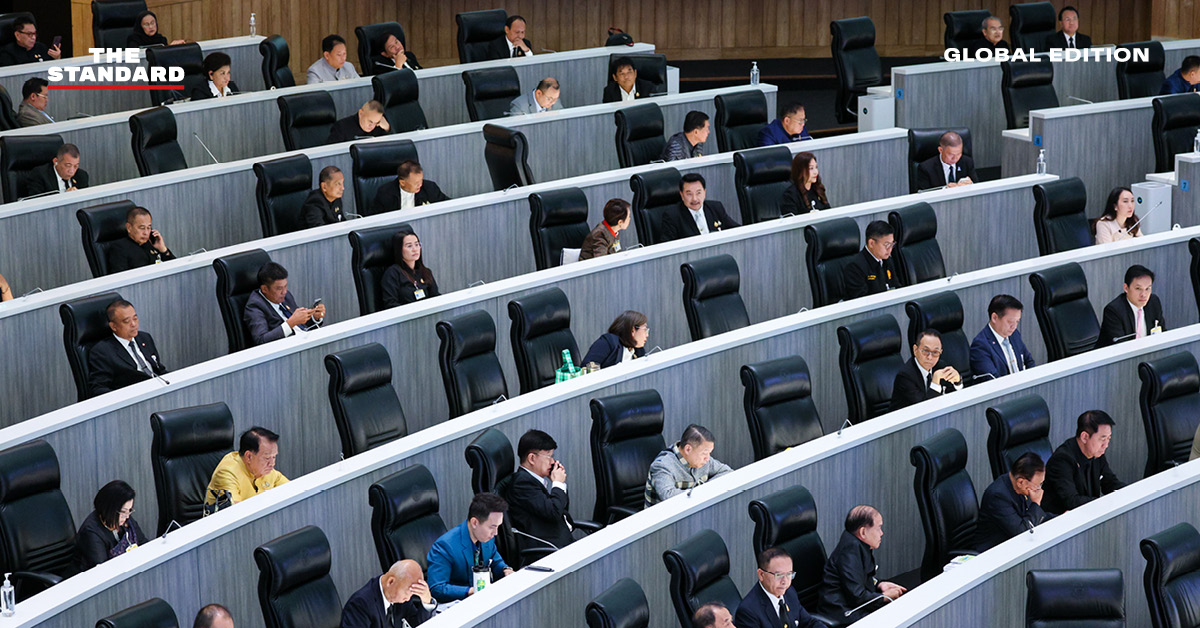
Two recent shooting incidents in Nonthaburi province, merely days apart, have thrust Thailand’s long problematic gun control issue back into the spotlight. On August 7 2026, a shooting occurred inside Debsirin Nonthaburi School, sending shockwaves and devastation across all facets of Thai society. The shooter was a secondary school student, and the attack claimed the lives of 9 victims, including the shooter himself, with over twenty people injured.
Key Point
Only three days later, former MP Chalong Riawraeng allegedly shot Police Colonel Thongchai Yenprasert, President of the Nonthaburi Provincial Administrative Organization, inside the organization’s very own office.
Whilst both incidents are separate and differ in context, they both expose the dimensions of Thailand’s gun problem. When a tragedy such as this occurs, it prompts society to step back, question the mechanisms in place, and wonder what could have been done differently.
The school shooting raises important questions about access and the systemic failures of state regulations regarding gun ownership. Meanwhile, Chalong’s case raises concerns about carrying weapons in public. How is it that a firearm can enter a government office and be used amid an escalated personal dispute?
The challenge here isn’t about firearm ownership rights, but about whether the state has the authority to manage where a weapon can trickle through society. This remains the key challenge, one the government must address.
A Regulated Environment With Scattered Ownership
Thailand’s firearms are governed by a single licensing regime that covers buying, owning, and carrying, and does not have a rights-based ownership system like the United States.
Yet, Thailand has one of the region’s highest levels of civilian gun ownership. A 2017 survey by Small Arms estimates civilian gun ownership in Thailand at approximately 10 million. Of this number, an estimated 6.2 million were properly registered, while roughly 4.1 million existed outside the registration system.
Although the data is now almost a decade old, it highlights the scale of firearms that are scattered across pockets of society. Taking into account the scale, this is why suspending new gun-purchase licenses and limiting the inflow of new firearms doesn’t quite address the problem at hand. The country still needs to manage the millions of firearms already in circulation, especially ones outside of the system.
A Distinction Between ‘Owning’ And ‘Carrying’
Former MP Chalong’s case has shed light specifically on firearm carrying, not just possession.
Prime Minister Anutin Charnvirakul responded by immediately issuing a mandate that bans the general public from carrying firearms outside of the home, and instigating stricter enforcement measures.
How meaningful a “100% no carry” order proves to be will depend entirely on real-world enforcement. This is typically where a loophole in Thailand emerges, and enforcement is crucial to prevention.
Real-world questions will demand thoughtful answers. How will the state detect an illegally carried weapon before an incident occurs, absent checkpoints or grounds for search? Will carrying firearms become more than a simple violation of rules? This is the question that ties it all together, as across parts of Thai society, owning a firearm is tied to power, status and roles of influential figures in specific areas.
The Argument For Guns
It comes back to the why. Firearms carry various meanings in Thailand. For some, it’s self-protection, tied to security duties. For others, it’s a true mark of power. Meanwhile, there’s also evidence of gun ownership for an increased sense of safety and self-protection.
In the long-term, Thailand’s gun policy is tied to an essential question. How much trust do Thais have in the state to ensure their safety without needing to rely on a personal weapon?
From Legal Firearms to Illegal Weapons
There’s another challenge. The line between a “legal firearm” and “illegal firearm” can be blurry. Some firearms are registered but later change hands, drop out of the registry, or enter an entirely unauthorized market. Others come through via border smuggling or online channels.
This discrepancy has led to requests for an amnesty period allowing illegal firearms to be surrendered without prosecution, to remove weapons from circulation, and to generate new insight on what’s circulating in the unregulated market.
This is a real-life example of the gap between Thailand’s above-ground system and the underbelly that runs in parallel across multiple sectors in the country. Laws and regulations in place don’t always apply to real practice.
When Guns Intersect With Bureaucracy and Power
A unique issue to Thailand is the “welfare gun” scheme, which allows certain groups of civil servants to purchase firearms at discounted prices. There’s a question of whether some of these firearms end up in the hands of third-party owners, and it prompted the proposals to restrict resale as well as investigations into how officials store their possessions.
The government has also ordered an end to the longstanding tradition of awarding guns as prizes to village and sub-district heads (kamnan and phu yai ban), replacing it with other kinds of rewards.
Firearms in this context is entwined with the symbolic relationship between weapons and state power. It will be difficult to untangle the cultural significance of firearms, as it has long been synonymous with status, power and privilege for certain groups. This aspect shares equal, if not more weight, with legal penalties.
Licensing Isn’t The Be All, End All To Gun Control
The recent school shooting highlighted how a one-time vetting of a firearm buyer’s qualifications is nowhere near enough. Now, there are demands to set new standards for home firearm storage, mental health evaluations and periodic re-registration mandates. This represents a shift towards overseeing a firearm across its entire lifecycle, beyond just the brief moment of purchase.
An owner’s circumstances can change, household members rotate with different situations and a firearm can change hands multiple times after the initial approval by the state.
What Happens When The News Cycle Moves On?
Whilst no one is discounting the government’s swift ability to mobilize agencies in a crisis, the real task at hand is turning those swift movements into a permanent system.
The siloed relationship between the civil administration and the police is well documented. Even with orders from the top, decades of separate structures make integration a challenge.
Firearms are not just a security issue, but a real test of the Thai state’s capacity to navigate families, unauthorized markets, bureaucracies, and tangible power networks with overlapping incentives.
Whilst the recent shootings have brought firearms back into the spotlight, success cannot be measured by checkpoints, arrests or suspended licenses alone. In this regard, the state will need to conduct a meaningful crackdown and reform of firearm ownership laws, one which will track and evaluate ownership and access and keep owners accountable for their possessions.
The real challenge here is the gap between the law and the state’s ability to manage a firearm’s lifecycle. The real work and accountability will have to continue even when it’s no longer front-page news.
THE STANDARD Global Edition is produced in collaboration with Bitesize Bangkok