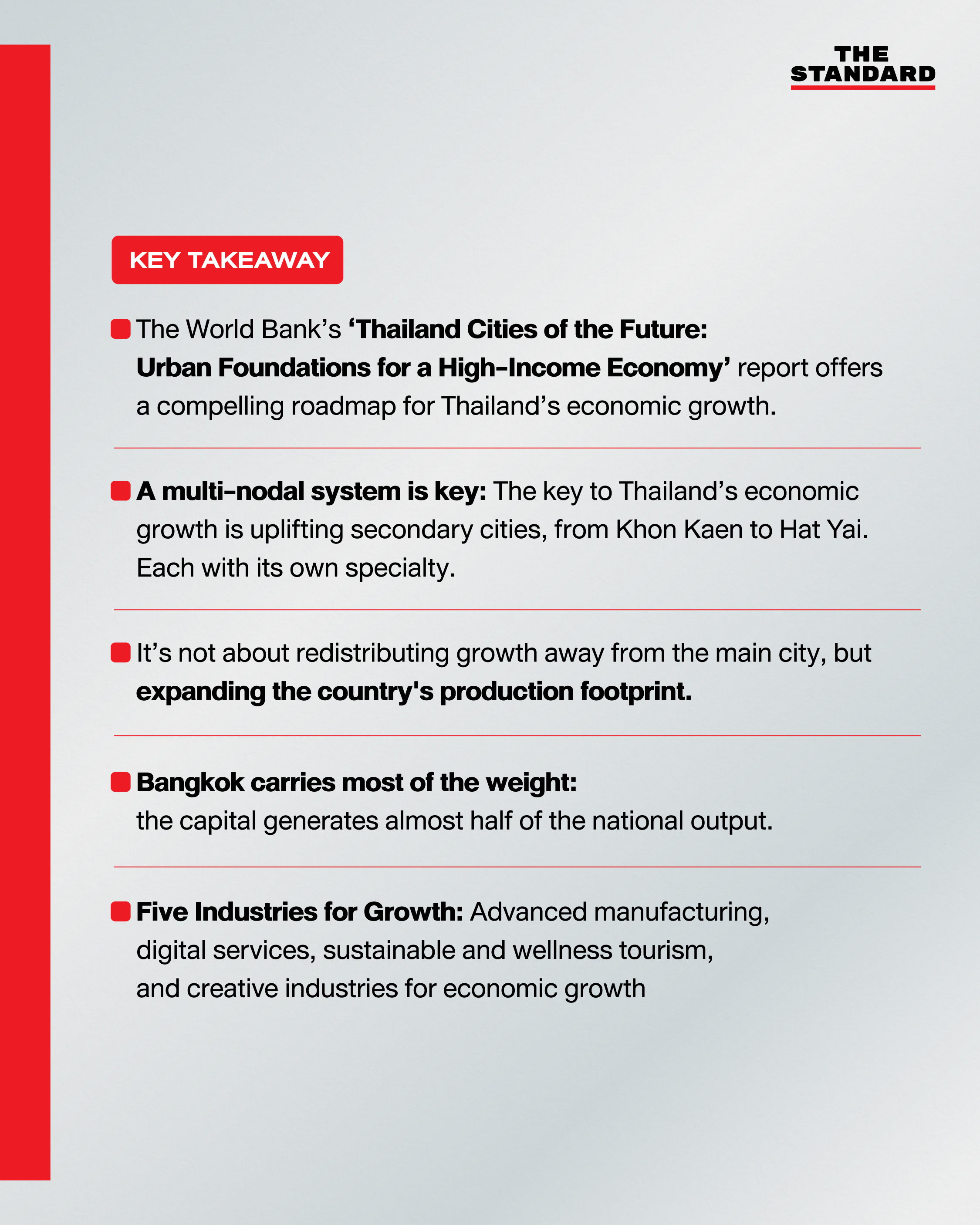
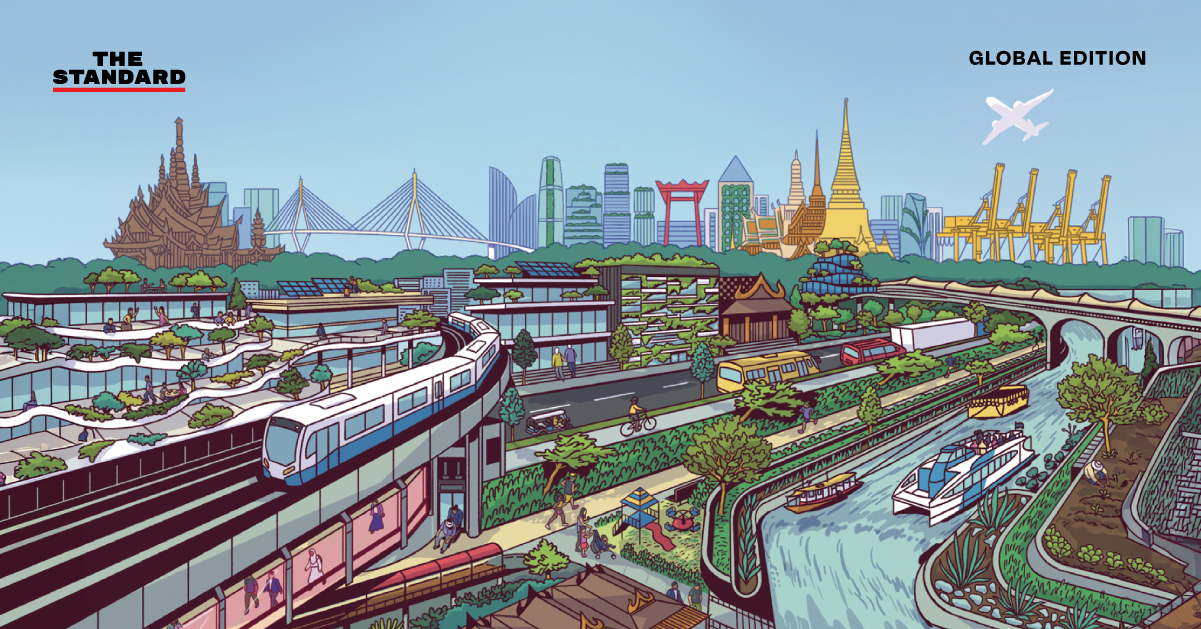
This week, the World Bank launched a report titled ‘Thailand Cities of the Future: Urban Foundations for a High-Income Economy’ in collaboration with the Program Management Unit on Area-Based Development (PMU-A) and the Urban Design and Development Center (UDDC), exploring how urban development of smaller cities can help drive Thailand’s economic growth and support its goal of becoming a high-income nation.
Key Point
The Bangkok Story
Comprehensive country assessments typically focus on productivity and skills at the national level. The World Bank’s report argues that Thailand’s next phase of growth depends on smaller cities, which is an idea often repeated but difficult to put into practice.
Thailand aims to achieve High-Income Country status by 2037, a challenging task given modest 1.9% GDP growth in Q2 2026 and structural shortcomings such as corruption, declining productivity, and high household debt.
The World Bank acknowledges that Thailand has already urbanized, but there’s a structural gap there.
What has not yet happened is the corresponding transition in urban performance: Thai cities have the scale and sectoral diversity of a middle-income urban system but translate these assets into productivity at rates closer to the lower bound of peer countries than to the frontier.
As ‘cities’ have been established as key to economic growth and rapid urbanization, linked to productivity, transport, industrialization, and integration with global markets, Thailand must prioritize its cities beyond Bangkok.
Whilst Thailand’s urban story cannot be understood without Bangkok, an overreliance on one highly urbanized capital has both risks and rewards. The report states that the Bangkok Metropolitan Region makes up almost 50% of Thailand’s economy.
The capital is currently experiencing some fatigue, burdened by the rising cost of economic concentration. The report estimates that congestion costs 7-10% of Bangkok’s GDP annually. Another statistic reveals that only 28.9% of the capital’s urban population live within one kilometer of a major rail station, despite sprawling rail expansion in recent years.
This is a deeply rooted infrastructure flaw, especially when compared with Seoul residents’ 67%. Whilst public networks such as BTS and MRT have improved accessibility, Bangkok’s overall network coverage still lags behind global benchmarks.
It’s not just about accessibility either, as urban planning points to structural challenges. Much of Bangkok’s growth has taken the shape of ‘superblocks,’ where large areas are accessible via only a handful of main roads, and the entwined streets within them lack connections. This funnels traffic onto only a handful of routes, making walking and non-car travel difficult.
Beyond this, rising heat is also costing economic opportunities.
The report cites that a one-degree Celsius uptick could reduce labor productivity by up to 3.4% for outdoor workers. The associated annual income losses are estimated at over THB 44 billion per year, or approximately 1% of Bangkok’s GDP.
Currently, the capital generates almost half of the national output, and this needs to be spread more evenly across cities with untapped productivity potential.
The report offers a sobering reality. Without structural improvements, Bangkok risks being overtaken by faster-reforming Asian and Gulf hubs with strong business ecosystems and better urban services, climate resilience, and quality of life for its residents.
Envisioning Thailand’s Economic Future
The World Bank outlines five key industries for Thailand’s economic future: advanced manufacturing toward EVs and semiconductors, digital services such as fintech, sustainable and wellness tourism toward high-spending segments, agrifood, and creative industries poised to drive cultural exports.
Many of these successes depend on spatial factors. For example, advanced manufacturing depends on spatial upgrading and ecosystem integration. Cities that have a cluster of suppliers, R&D, logistics hubs, and engineering talent will be well positioned to capture emerging value chain segments.
As Thailand continues to face a shrinking and aging labor force, coupled with skill deficits, cities that can attract skilled workers and facilitate adult learning will play a crucial role in increasing economic opportunity.
Why Thailand Needs a Multi-Nodal System
OECD analysis shows that multi-nodal urban systems are associated with higher national GDP per capita.
This is not about redistributing growth away from the main city, but about expanding the country’s production footprint. It’s an intentional shift from a single economic engine to a network of engines, whilst Bangkok can continue to serve as the anchor.
There are examples to draw from: Berlin operates alongside Munich, Hamburg and Frankfurt, as does China’s growth story. Successful systems draw on the strengths of different metropolises without dismantling them.
As secondary cities mature, they can attract talent and investment while serving different specialties. This kind of spread can ease pressure on Bangkok, whilst raising productivity across other areas.
In this case, the question is how the government can build up secondary hubs such as Chiang Mai, Khon Kaen, Nakhon Ratchasima, and Chon Buri. Returns may take longer to materialize, but ultimately, economic benefits will spread nationwide.
The government has begun planning for this through its 20-Year National Strategy (2018–2037) and the 13th National Economic and Social Development Plan (2023–2027), which elevates ‘smart and livable cities’ as a strategic milestone.
Uplifting Secondary Cities
The report identifies a set of secondary cities that could take on a far larger share of Thailand’s economic activity, each playing to distinct strengths rather than competing for the same role.
Chon Buri, Nakhon Pathom, and parts of Songkhla can be uplifted as industrial centers. Hubs such as Khon Kaen, Ubon Ratchathani, and Nakhon Ratchasima can serve as gateways for surrounding rural economies, with Khon Kaen positioning itself around health, education, and MICE activities.
Meanwhile, Chiang Mai and Phuket hold strengths in creative industries and wellness.
Hat Yai stands out for its role in cross-border commerce. As a major gateway for trade with Malaysia, the city handles cross-border flows exceeding US$28 billion annually, making it a critical node in Thailand’s links with the rest of Southeast Asia.
Key Takeaway
The report offers a compelling way of thinking about growth and productivity in Thailand. Its core thesis is that Thailand can escape its middle-income trap by building up secondary cities and local economies through a network of cities that lean on their own strengths, while the capital anchors the system.
It’s a persuasive argument, but not an easy one to deliver. Turning the framework into measurable results will demand significant investment and policy discipline across different government cycles.
Strong governance and transparency will be key, as will a coherent national blueprint that coordinates across every level of government. Building out Thailand’s secondary cities will require the country to tackle its structural challenges, dismantle corruption and continuously boost productivity across key industries. Only then will Thailand have a meaningful chance at transitioning to a high-income economy.
THE STANDARD Global Edition is produced in collaboration with Bitesize Bangkok