Christopher Nolan still believes one thing remains irreplaceable in the AI age: human creativity.
Key point
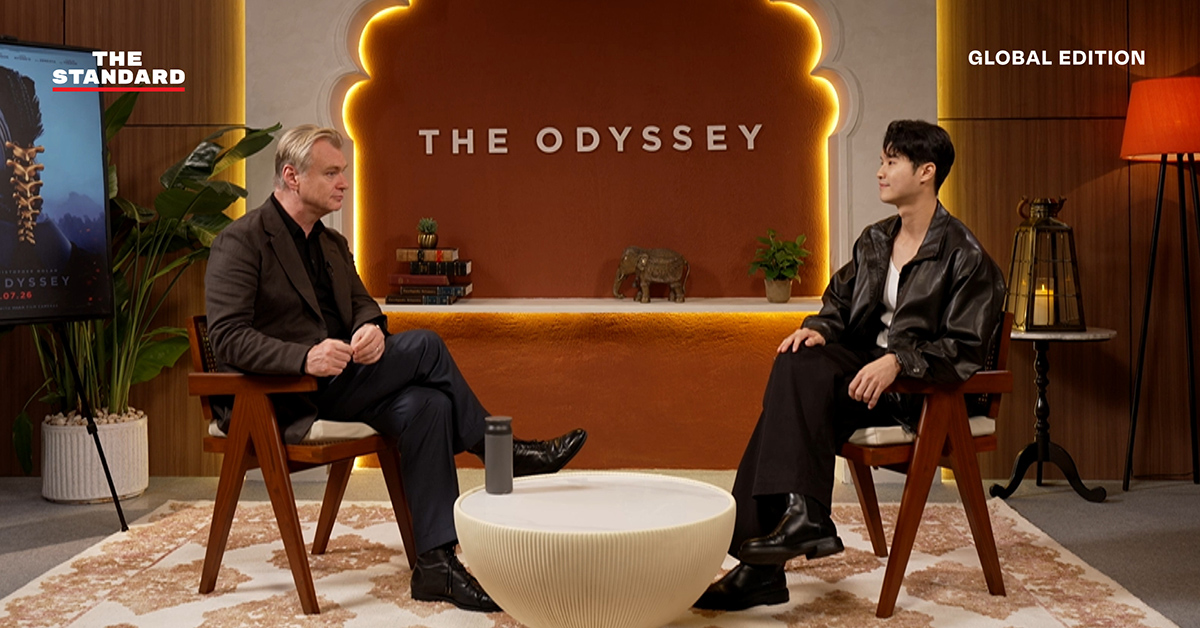
I traveled to Mumbai, India, to attend the premiere of The Odyssey and interview Christopher Nolan, Matt Damon, and Tom Holland.
Beyond the confines of the interview room was bustling Mumbai, a city filled with color, car horns, crowds, and restless energy. When the door closed, though, everything grew strangely still, and the crew began preparing their equipment and starting the countdown.
“Five, four, three, two, one.”
Christopher Nolan took his seat across from me.
There’s a stillness to him, a composed and quiet authority. Nolan was attentive throughout our conversation and engaged with his full attention.
A tumbler of tea was placed near him. He would lift it to sip every so often, unhurried, even though we were on a schedule.
Christopher Nolan needs almost no introduction. He is one of the few master storytellers and directors of this era able to stand firmly at the intersection of art, technology, and mainstream cinema.
From Memento, which turned memory itself into the structure of the story, to Inception, which layered worlds within dreams, to Interstellar, which took audiences to the edge of the universe whilst paying homage to a father-daughter bond, through to other blockbusters like The Dark Knight, Dunkirk, Tenet, and Oppenheimer, Nolan has built a career out of pushing countless boundaries.
Nolan is a rare kind of Hollywood director who commands mainstream popularity whilst also carrying an intellectual ambition of the highest order. His name alone can carry a film, and he experiments with complex concepts such as time, structure, and perception, yet draws the popcorn crowd.
Thai fans show their worship by slapping the nickname ‘Sadet Phor Nolan’ (Father Nolan).
Following the Best Picture and Best Director awards at the Oscars for Oppenheimer, Nolan had nothing left to prove and made a very conscious Nolan decision to go back 3,000 years in time.
📌 The Odyssey: A 3,000-Year-Old Story Retold to a World Changing Faster Than Ever
The Odyssey is Homer’s Greek epic about Odysseus, King of Ithaca, and his attempt to return home after the Trojan War — a journey that should have ended with the war but instead stretched on for another ten years, through seas, gods, monsters, temptation, loss, and the consequences of his own choices.
This is not merely the story of a warrior trying to survive, but of a man who has been through war and must find his way back — to his home, his family, and his own identity.
For Nolan, the story’s appeal doesn’t require an elaborate theory to explain.
“I try not to over-analyze myself too much when choosing projects,” he said. “I want to be drawn in by the story and the characters.”
“Homer’s epic has captivated generation after generation for almost 3,000 years, because it’s a story about the journey home, coming of age, love, war, and death, all at once. That’s what drew me in. The reason this work has endured is that it carries universal, accessible truths about being human.”
It’s a striking and candid answer from a director so often discussed in terms of the future of cinema. After making films about dreams, time, space, war, physics, and nuclear weapons, Nolan has chosen to move forward by reaching back to one of humanity’s oldest stories.
Perhaps novelty isn’t about escaping old questions, but merely about returning to the same fundamentals in a world that has altered.
War, uncertainty and rapid technology adoption has changed the way we view the world, and AI is emerging as a test across multiple professions. Somehow, it makes The Odyssey’ centuries old questions oddly relevant.
When I asked what makes a storyteller great in an age when AI can create almost anything, Nolan’s answer was simple.
“I think it’s human creativity.Nothing can replace human creativity.”
Nolan describes human creativity as a process involving communities and thousands of people coming together.
“When you make a film, you’re working with thousands of people. Everyone brings their own imagination and spark of creativity, from the production designer, the cinematographer, the visual-effects supervisor, all the way to actors like Matt Damon, Tom Holland, and Anne Hathaway. Everyone brings their own interpretation into the work.”
On set, Nolan tries to act as ‘an audience member.’
“I try to guide people, and I try to act like an audience member when I’m on set.”
Nolan insists that despite the film’s advanced filmmaking technology, the film is made in a purely analog way, with human creativity at the forefront.
📌 The Right Leader For The Job
Undertaking a Director’s role in an epic like The Odyssey is similar to steering a large organization. The role requires one to translate a vision into tangible decisions, logistics, working systems and a shared belief.
This is why I was interested in Nolan not only as a director, but as a leader.
When I asked how he draws the best out of his team, Nolan’s answer was refreshingly straightforward.
“I try to be the kind of director they need me to be.”
This is true especially when working with actors, where Nolan’s job is to listen, observe, and understand what each person needs.
“I love actors. I like helping them, even though each one has a different process. But they’re able to come together and adapt naturally to each other’s style. So, I try to listen, notice what they need, and give them that. Sometimes, you have to step back and let things unfold in their own way.”
The Odyssey shot for 91 days across 6 countries, leveraging real locations, open seas, and uncontrollable weather, yet the crew wrapped 9 days ahead of schedule.
Matt Damon, who plays Odysseus, said this was the hardest role of his lifetime. Looking at the scale of The Odyssey, he felt what Nolan was attempting was almost impossible.
“What I learned is that you can dream something that’s impossible and make it happen,if you are well prepared.”
At the end of a gruelling day on set, people would look around with the feeling that they achieved the impossible.
“Wow, we actually did it. Okay, let’s come back tomorrow and try again.”
And the next day, it’s a matter of picking up where they left off and doing it all over again.
📌 Technology That Mimics the Human Eye
The Odyssey is the first film shot entirely on IMAX. The production used more than 2.1 million feet of 70mm IMAX film and developed a new camera called the Keighley, along with a sound-blimping housing that let the IMAX camera record sound and image simultaneously for the first time.
Fulfilling ambitions from his teenage years, Nolan says traditional IMAX film cameras were large and cumbersome, placing major limits on dialogue scenes and close-ups. So, he developed a new sound system with a team which will now open up new possibilities for filmmakers.
Tom Holland says collaborating with Nolan was a drastic shift from his prior ways of working.
“When you read a script, you’re programmed to think, ‘this scene definitely needs CGI, and we’ll probably shoot it in a studio.’”
But Nolan expressed his aim to build out a scene and shoot on location
The production used real ships, large-scale physical sets, and real locations across multiple countries. Nolan explained that he wanted scenes to emulate like documentary footage, and for actors to be immersed in the reality.
“There were days on set that I’m still trying to process, even now. I’m glad he didn’t reach out to me five years ago, because back then I don’t think I would have been ready to handle a film of this size,” he says.
Sometimes, we need to grow into being ready for opportunities.
📌 The House Nolan Built
The Odyssey is one of the most important homecoming stories in human history.Odysseus spent ten years at war, and another ten years trying to get home to Ithaca whilst encountering vices from joy and temptation along the way.
Yet, the story’s pull remains rooted in one place; home.
When I asked how the film changed the meaning of ‘home’ for him, Tom Holland began by talking about how fortunate he feels.
“The thing I’m most grateful for in my life is my family. They’re my anchor, my community, and the foundation of my everyday life. So much of what I’ve achieved traces back to lessons from my parents and siblings.”
Matt Damon echoed the sentiment, “I don’t think it changed my perspective, but it deepened the feeling.”
For Nolan, the meaning of home changes with age and with the stage of life you’re in.
“As you get older, especially once you have a family, home comes to mean less about a physical place or location, and more about being surrounded by friends and family.”
Throughout the making of The Odyssey, the crew traveled across the world, but Nolan said they still felt a sense of connection and togetherness.
“I think that’s what having a home really feels like.”
A few minutes later, the cameras stopped rolling. I stood up and said my goodbyes. Outside, Mumbai was still moving at its own pace.
One sentence stayed with me.
“As we get older, home comes to mean less about a place, and more about being surrounded by the people we love.”
Perhaps Odysseus needed ten years to discover that. Nolan needed one epic.
As for the rest of us, perhaps we’re still on our way.
THE STANDARD Global Edition is produced in collaboration with Bitesize Bangkok