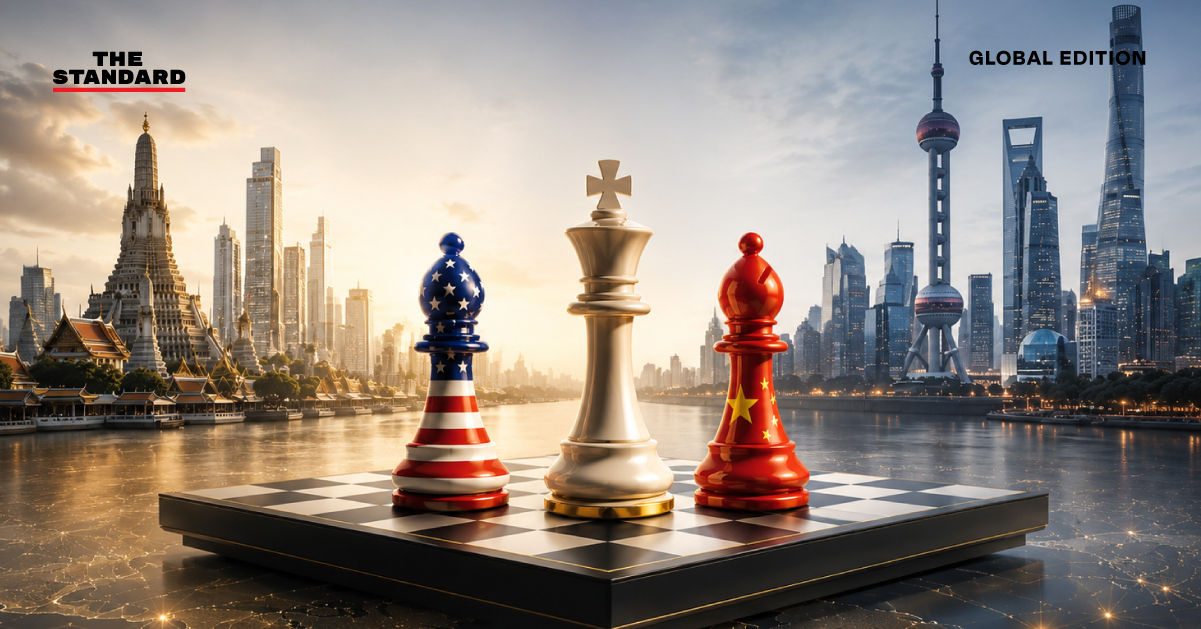
When Chinese capital coincides with US Trade barriers, Thailand has to navigate through its neutrality. The real stakes isn’t merely about choosing between the superpowers, but whether Thailand has the ability to remain neutral.
Key Point
Thailand is currently tasked with navigating a challenging diplomatic landscape, amid the country’s renewed focus and commitment in opening its doors to capital, technology and manufacturing capacity from China. Simultaneously, the United States is challenging the status quo of the decades’ old export market.
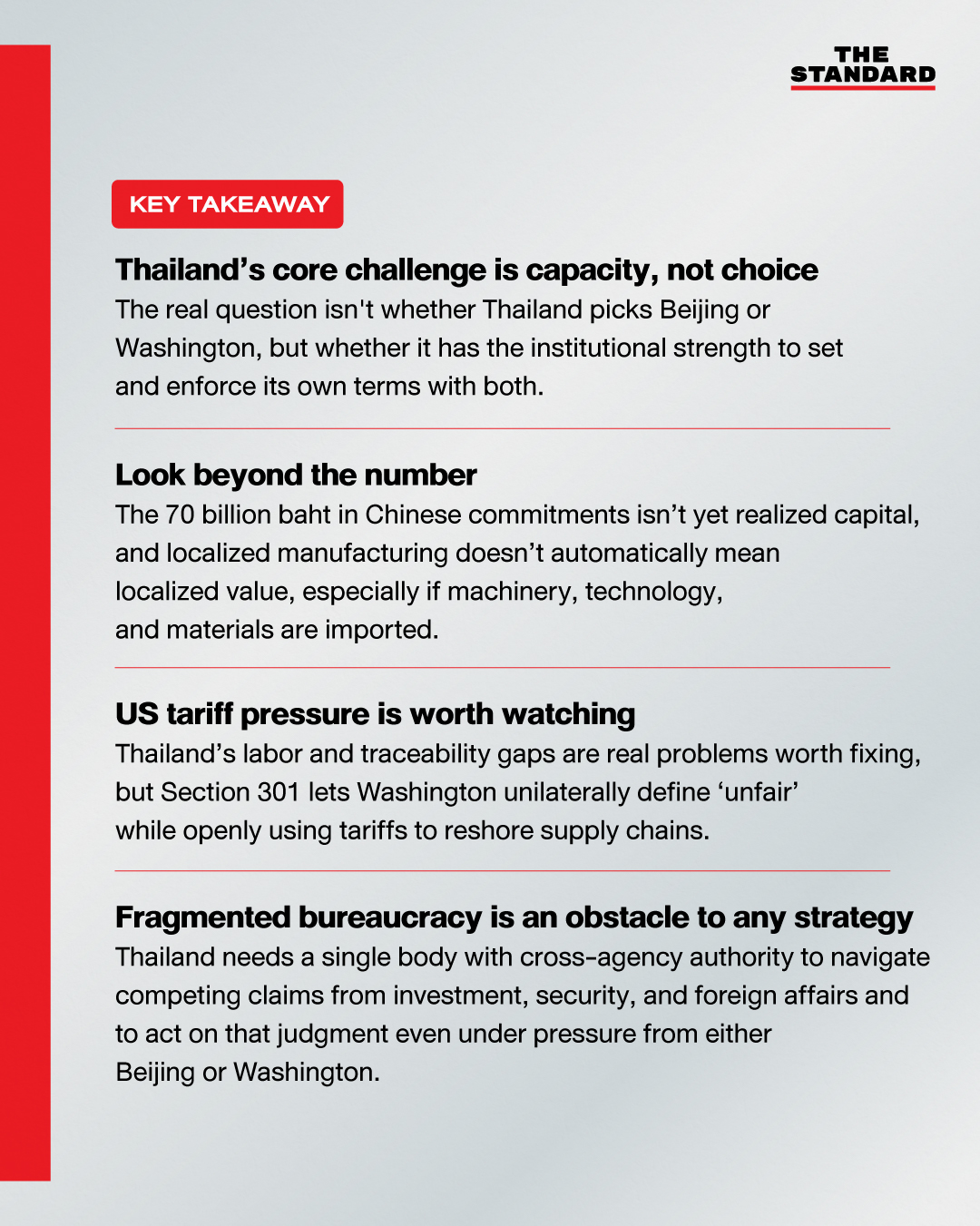
We often speak of choosing sides, but the real question is whether Thailand has the legs to dictate its own terms under such conditions.
Behind China’s 70 Billion Baht Commitment
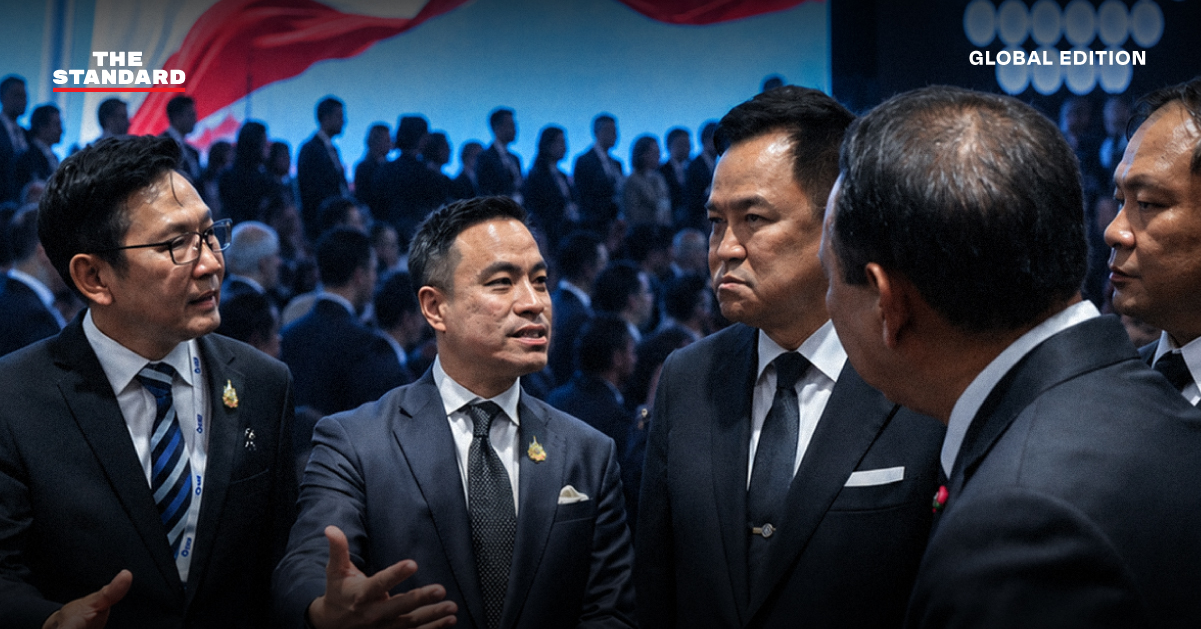
Prime Minister Anutin Charnvirakul’s first official visit to China as head of government from July 16–20, 2026 sent a clear signal. The Prime Minister met with President Xi Jinping, Premier Li Qiang, and other senior Chinese leadership, attended the World AI Conference in Shanghai, and led a delegation of public and private sector figures on an investment roadshow in Chengdu.
The trip was declared a diplomatic success by the government, and Thailand returned with two commitments that need to be kept separate. The first is 15 cooperation documents covering science, space, education, AI and more. The second is a series of commitments from Xiaomi, ChangAn, InnoLight and Eoptolink to expand their investments in Thailand by approximately 70 billion baht.
This figure, although substantial, does not currently represent tangible investment into the Thai economy. Success should not be purely defined by the figure alone, and there should be a full disclosure of project and investment timeline, state incentive details and details regarding Thai components and involvement, as well as technology transfer.
This is the real distinction when it comes to value creation. Factories and manufacturers located in Thailand doesn’t automatically translate to localized industry benefits, especially if the machinery, technology and raw materials are mainly imported, leaving Thailand to bear the land, energy, water and labor costs.
The joint diplomatic Thai-China statement references ‘quality investment’ and local business participation with technology transfer. This rhetoric will need to be expanded into trackable conditions in order to assess their real impact.
When Chinese Capital Coincides With The US Trade Wall
Within the same time frame, the United States announced additional Section 301 tariffs of 12.5% on Thai goods that are not on the exemption list, tied to Thailand’s insufficient measures against imports made with forced labor.
Thailand’s labor law has truly become a significant weakness. There needs to be a thorough overview and fixing of discrepancies in labor law, traceability and rules of origin, given that the US ran a US$71.9 billion goods trade deficit with Thailand in 2025 and is currently investigating the country over structural excess manufacturing capacity.
This doesn’t exempt Washington from some level of scrutiny either. Section 301 is unilateral by design: US domestic law, letting Washington itself define what counts as ‘unfair’ and wield tariffs to compel change. At the same time, the US government has openly acknowledged that these measures are a part of reshoring supply chains.
Both Beijing and Washington are wielding economic relations in service of strategic expectations, only using different vehicles. China’s leverage is capital investment and supply chain linkage, whilst Washington has the market size, tariffs and trade rules in its corner.
Whilst Thailand shouldn’t cave quickly to US demands, it also cannot dismiss the country’s scrutiny over labor laws as merely external pressure. Thailand’s objections to unreasonable US measures will only carry weight if it can demonstrate that its exports genuinely generate domestic value, not merely serve as a transshipment point for circumventing trade restrictions.
The Invisible String: From Economics to Security and Public Discourse
Thailand and China relations have since expanded to include the establishment of a ‘2+2’ mechanism between each country’s Defense Ministers to expand strategic coordination and relations. Whilst cooperation could help tackle call-center scam networks, human traffic and transnational crime, Thailand also has the obligation to define the scope and risks of potentially being over-dependent to any single country’s regulations.
The Taiwan tension is perhaps the most revealing case. Thailand has long adhered to a One-China policy, but the latest joint statement endorses Beijing’s position in unusually specific terms, affirming Taiwan as part of China.
Reuters has previously reported that a Bangkok art exhibition removed or altered works touching on Tibet, Xinjiang, and Hong Kong following pressure linked to the Chinese embassy. In July 2026, organizers of a Taiwanese film festival alleged that Chinese embassy officials tried to have Taiwan’s Ministry of Culture name and logo removed from promotional materials. The Embassy has yet to respond to this claim.
The government needs to draw a distinct line. A One-China policy is a framework for state-to-state relations, but not a license for foreign interference in regards to matters of Thai media, universities or cultural institutions may present.
Navigating Challenges For ASEAN and Thailand
Thailand has carved a significant role for itself between the global leaders. The country matters precisely because it occupies a specific structural position as the only US treaty ally in mainland Southeast Asia, even as its own ties with China deepens. That dual positioning is what make the country’s choices consequential beyond its own borders.
If Thailand is able to convert Chinese capital into meaningful technology transfer with real value add, whilst adhering to the standards that keep exports credible in Western markets, then Thailand can evolve to become a valuable player in the model of supply chain diversification. However, if Thailand ultimately functions as a final-assembly base for Chinese production, there’s a real risk which can cast doubt on the whole of ASEAN’s manufacturing base with potential consequence on trade barriers.
The phrase ‘Thailand must set its own terms’ is meaningless if vehicles such as investment promotion, customs, labor and foreign affairs continue operating in silos. What’s missing is a mechanism with end-to-end accountability, one that can demand investment conditions and assigns responsibility and roles across data & technological risk, and balances investment incentives with protecting exports.
Thailand needs to carve out specific investment conditions. Investment must generate domestic value and capability, traceable exports and cooperating on security and data must have clearly defined lines from media and public spaces.
There is no need for Thailand to distance itself from China to placate the US, nor should it move closer as a reactive response to Washington’s pressures.
Striking a balance in this context is fundamentally a matter of state capacity and harboring the ability to determine whom Thailand cooperates with and on which grounds regardless of diplomatic pressure from either side.
True balance is proactive as it requires Thailand to have already answered questions like which sectors are open to Chinese capital and under what conditions, what labor and traceability standards are non-negotiable. What this requires is a government body with cross-agency authority, one able to weigh competing claims from investment, security, and foreign affairs and to act on that judgment even under pressure from either Beijing or Washington.
THE STANDARD Global Edition is produced in collaboration with Bitesize Bangkok