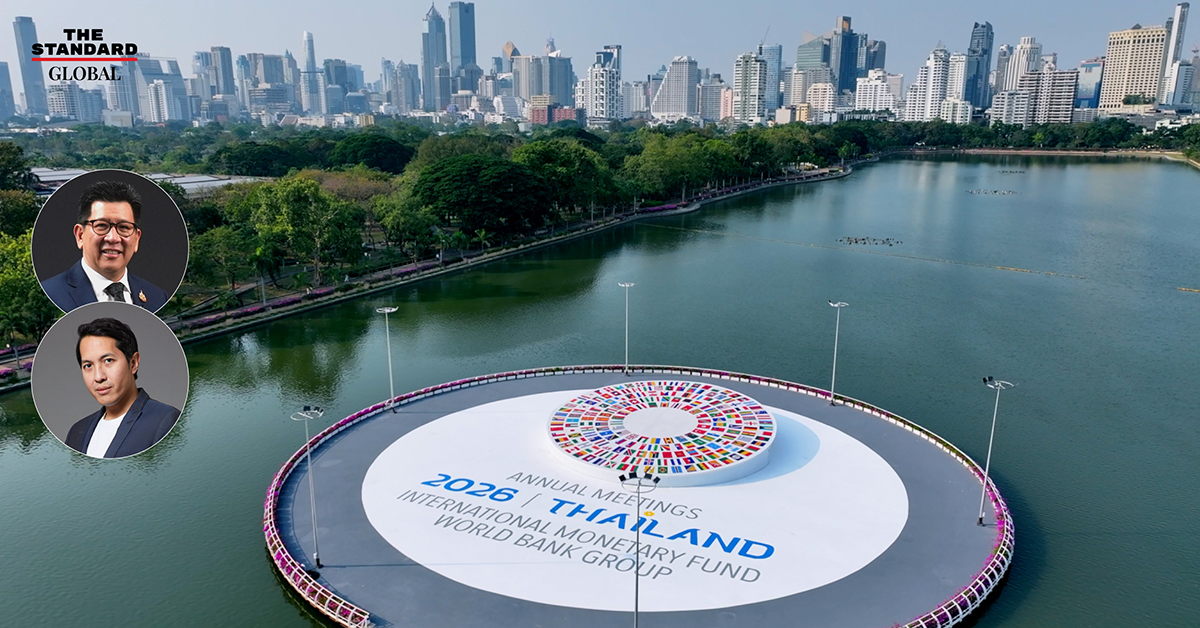
For decades, Thailand has been seen as a fun country to visit, like visiting a good-time friend. During a sit-down with THE STANDARD, Vice Minister of Finance Dr. Santitarn Sathirathai says this perception is starting to shift.
Key Point
“Thailand’s brand value is shifting,” says Santitarn. “The impression from investors and delegates this year is that Thailand can be a potential partner, not just a friend.”
The IMF–World Bank meetings showcased Thailand’s soft power, from community-made textiles and the Thai Pavilion to the Young Critical Policy Designer programme, where Thai students exchanged policy ideas with global leaders. Combined with a week of warm hospitality, this left Thailand well positioned to turn goodwill into meaningful economic gains.
Thailand’s Post-AI Boom Path
“The early phases of any technological wave have historically been prone to over-investment,” says Santitarn. The real question is, no one knows how long the AI boom will last, and whether the wave is sustainable.
Given that Thailand is already benefiting from exports, the real work now is figuring out how to leverage this to build domestic capabilities.
“We must diversify our risks, but at the same time, make the most out of this wave. This links to Thailand’s All-in AI and AI in Action initiatives. What we’re seeing most clearly right now is All-in AI, which means becoming part of the supply chain. Once we’re in, we can grow alongside it.”
For Santitarn, it’s worth investing in components and parts that can fuel AI and also have industry-spanning use cases, not just focus on one singular use.
“Photonics, sensors, power electronics and memory,” he says. “These technologies can also be used to power next-gen mobility, the green industries and healthcare.”
In parallel, the government is pursuing structural reform through the Joint Public-Private Sector Consultative Committee (JPPCC), which has set up an ‘Intelligence Economy Transformation’ working group to embed technology in the real economy.
“On data centers, policymakers must weigh demand against the rise of smaller, more energy-efficient AI models,” says Santitarn. “Next year, we’ll shift from headline investment figures to quality growth, measured by real value creation, such as high-skilled jobs and R&D partnerships with Thai universities.”
Meanwhile, policy clarity is expected before year-end on regulations governing data centers and on a framework for Direct PPAs. The latter addresses a key requirement for global data center operators, many of which have committed to running on clean energy.

Investors Will Watch Thailand’s Infrastructure Investment
“Thailand’s debt ceiling is approaching 70%,” says Santitarn, “but this isn’t the real concern for investors and credit rating companies. Their real worry is that Thailand may hold back on infrastructure and development spending out of concern over the debt ceiling, which will ultimately harm our growth potential.”
Turning to growth, Santitarn says Thailand faces a two-layered problem. The country’s potential growth has fallen from above 3 percent to around 2.7 percent, and actual growth is lagging even that lower benchmark, running at only about 2 percent.
“Ultimately, we have to fix growth first. Once growth improves, government revenue also improves.”
Santitarn points to bond yields as a gauge of Thailand’s fiscal credibility: the 10-year yield sits at around 2.3 percent, against over 5 percent in the US. With borrowing capacity and liquidity solid, he argues, the real concern is growth.
Thailand’s Brand Is Changing, But There’s Work To Be Done
“Thailand’s brand is changing,” says Santitarn. Long seen as a friend who is fun to spend time with but not a serious business partner, the country is now being viewed differently.
Thailand is building on that shift, using this week’s meetings to lay the groundwork for a pipeline of engagements ahead of next year’s Davos. Its planned entry into the OECD will add a further layer of accountability.
“These engagements are a good source of pressure. It’s like having a teacher constantly checking our homework,” he says. “It keeps us accountable and working hard.”
Still, the real work begins at home. Asked why the optimism has yet to trickle down to ordinary Thais, Santitarn says it is natural for the public not to feel much change yet, as the country is still in the early stages of its transition.
Meanwhile, the 3Cs are bottlenecks to Thailand’s high-income ambitions: clarity, coordination and continuation.
While the country has gained some clarity on its direction, the other two remain works in progress. “Thailand needs to strengthen collaboration across government, the private sector, and academia,” he says. “There’s also a need for policy continuity; otherwise, we will never see long-term results.”
That coordination extends to the labor market, which is squeezed by an aging workforce on one side and the threat of AI on the other.
Santitarn argues the education system must help graduates land their first jobs by producing ‘AI bilinguals’: workers who pair specialist knowledge with the skills to put AI to work. For Santitarn, this is the key to ensuring the economic gains reach ordinary Thais, through more jobs, stronger consumption, and broader growth.