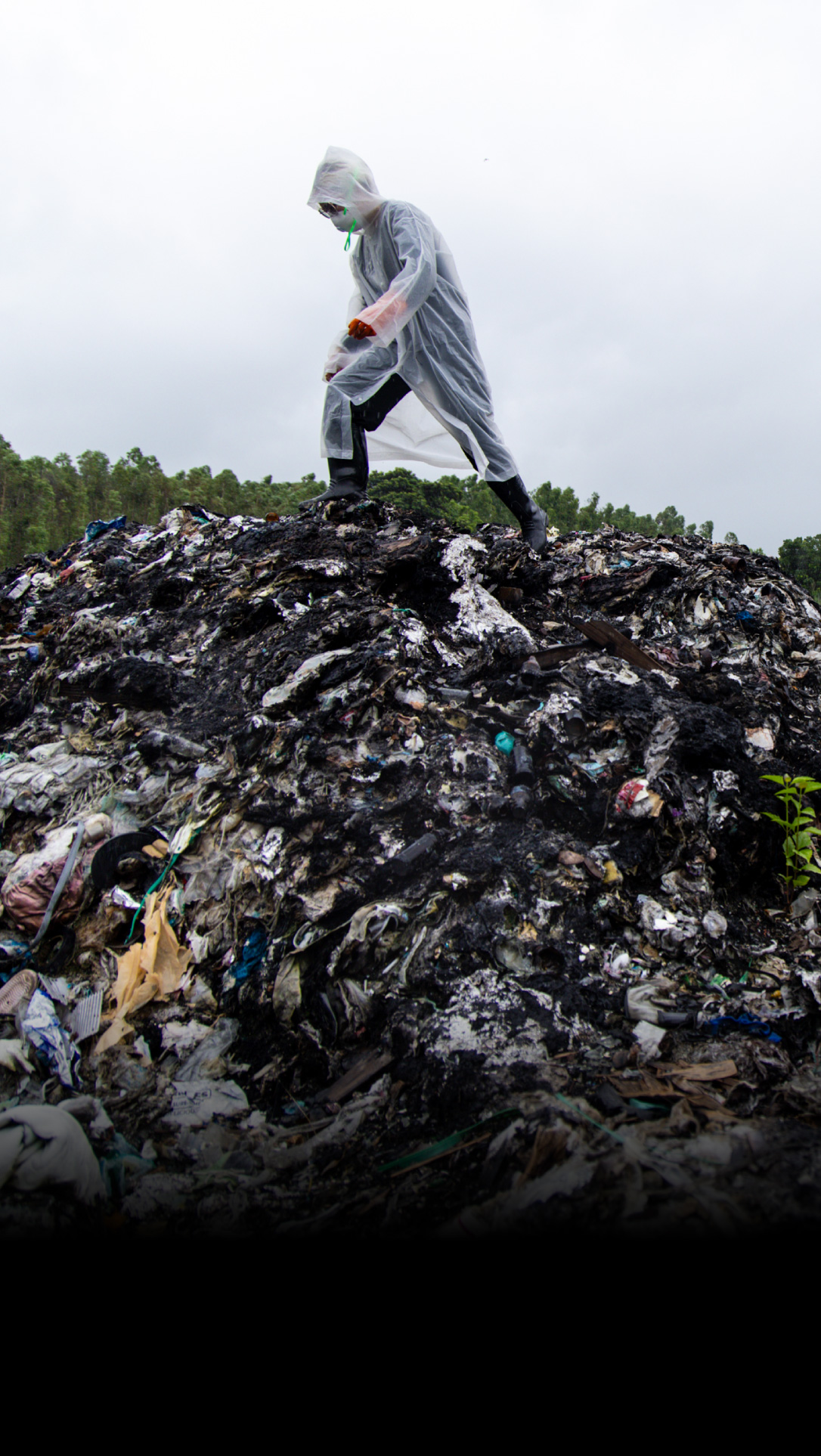

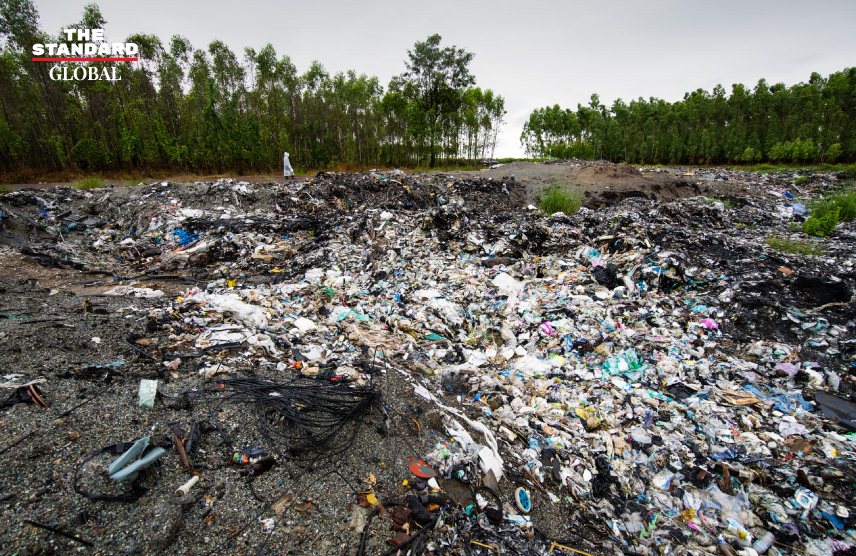
“The further we walked, the more we saw just how many different kinds of things had been dumped there. Thinner containers with Chinese-language labels, glass bottles that looked like medicine vials. Everything was covered in mud and soaked with water, all mixed together until you could barely tell anything apart.”
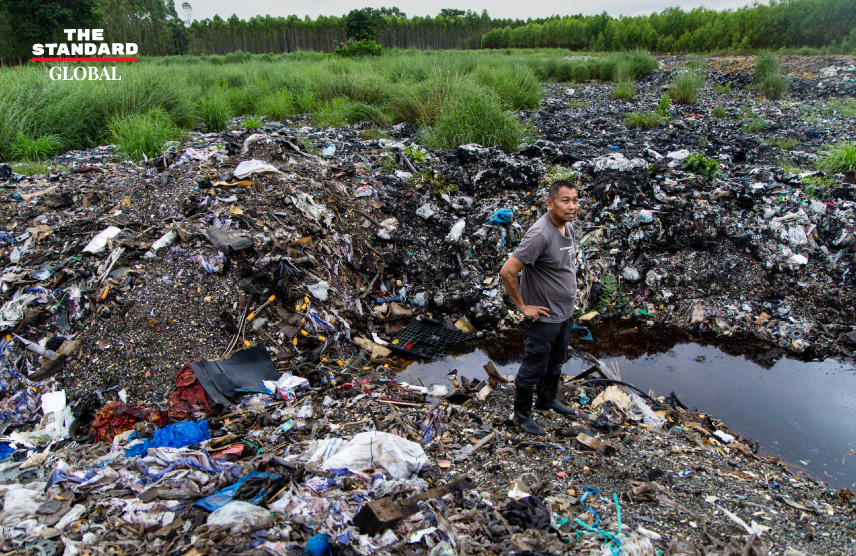
That is how Sumet Rianphongnam describes a plot of open land in Prachinburi, one of many illegal dumps across the province where electronic and chemical-laced industrial waste has been piling up for years. Born and raised in the area, Sumet has become an environmental community rights defender and part of the Khon Rak Krok Sombun group, locals in the Krok Sombun subdistrict who have banded together to protect their hometown.
It’s working, and local voices have only gotten louder, prompting government officials to finally pay attention.
The extent of the industrial waste is hard to convey. Everywhere you look, something is carelessly discarded and piled up, pointing to years of systemic neglect. Electronics, bottles, gloves, and warning labels.
A chemical smell rises from the pond, and it gets heavier when it rains. “Every kind of waste ends up here, and this is the free soil,” says Sumet.
“Villagers didn’t know what it was at first; this is the solvent that’s been dumped. Solvent is the oil used to wash machinery. Once it’s used up and spent, it has to be thrown away, and it’s supposed to be properly disposed of too.”
Because the dump sits on high ground, Sumet said, contaminated runoff can travel from the village water-supply reservoir into the rice fields, irrigation canal and nearby river. Residents have already told him they’ve been itching after bathing, something that “never used to happen before.”
This is the real silent danger. As the waste piles up, it begins leaching into the food chain and nearby community water sources, with farmland and cornfields becoming repeated dumping grounds.
“When it rains, chemicals from dump sites run off into the irrigation system, impacting village water-supply reservoirs and rivers, and directly affecting the water used for drinking and everyday life,” says Sumet.
There’s More to the Story
According to a local source who spoke with THE STANDARD, coming forward about industrial waste and hazards comes at a cost. After villagers alerted authorities to the realities, people approached them, demanding to know “who said this” and “who told you?” For the local community already living with the fallout from illegal waste, the question became what they could safely reveal about the conditions surrounding it, raising concerns about systemic flaws and structural failures.
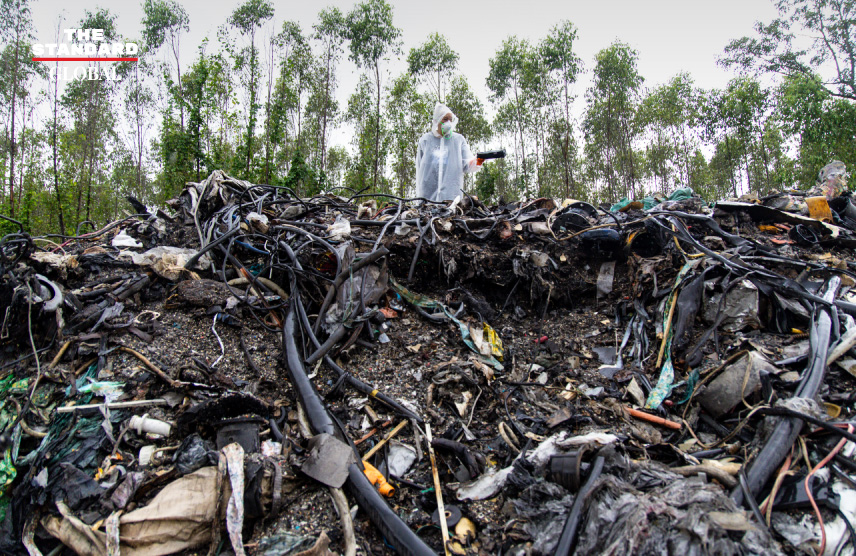
The pressure to silence people raises a significant question. How did the piles of waste end up here, how can those responsible be held to account, and how can the land be restored so people wouldn’t have to live this way?
After heavy rainfall, floodwaters overflowed from the landfill operated by Green Environment Technology Co., Ltd., producing rainbow-colored, oil-like sheens in the Hua Wa subdistrict; the Department of Industrial Works issued a Section 39 order temporarily suspending the plant’s operations.
Industry Minister Varawut Silpa-archa said initial inspections found an oil slick and detected no toxic substances.
“Every batch of waste should be traceable,” says Sumet. “In reality, we continue to see waste dumped in fields and farmland across the area; how is this waste escaping the chain?”
In this case, it’s the local people who have spoken up and advocated for their hometown, highlighting deeply rooted systemic failures.
“Prachinburi has completely failed at managing environmental problems. Not a single case has been successful, whether in solving the problem, making arrests, or prosecuting. And from what we’ve seen, there has never been a single case where a complaint was filed by a civil servant or a politician.”
The deeper issue isn’t the waste itself, but what it leaves behind for the communities living beside it: uncertainty about the water they drink and bathe in, the air they breathe, and the soil they grow their food in.
The Government Response
Images and accounts of the industrial waste spread widely, prompting a government response in the past couple of weeks. Natural Resources and Environmental Minister Suchart Chomklin vowed a full-scale crackdown and ordered the Pollution Control Department (PCD) to inspect the site, work closely with relevant agencies, identify the cause, and find a solution.
The department’s Regional Environment Office 7 (Saraburi) was working with local agencies, led by Prachinburi Deputy Governor Chanathip Khokmanee, along with local administrations, public health officials, district agriculture and irrigation offices, the waterworks authority, and community networks, to collect water samples for testing.
Initial inspections upstream of the Khlong Phet Oem sluice gate found that it had not yet been opened to release water into the Prachinburi River. The findings showed that the brownish-black canal water had a slight odor, with volatile organic compounds (VOCs) measured at 0.8 ppm at one of five sampling points, a level the PCD said posed no significant health risk.
Just days later, the agency apologized for swapping its ammonia and aluminum readings in tests on further testing regarding fish deaths in Si Maha Phot. The corrected figures showed elevated aluminum, which the department says it is still investigating as a possible cause.
The PCD plans to sample sediment once the floods recede, focusing on two points: the Ban Nong Hoi river-mouth bridge and the Prachinburi River bridge in Kabin Buri. It said the aluminum levels pose no direct health risk unless people drink the water over a sustained period.
Looking Ahead
As officials respond and testing continues, residents will have to live with the consequences until they find the source of the waste and hold those responsible to account. Industrial waste does not pile up on its own, and its effects reach from the water people drink to the land they farm, leading to affected businesses and groups such as fish vendors and the food they eat. Residents like Sumet will keep advocating for their right to speak out, even though it has already come at a cost.