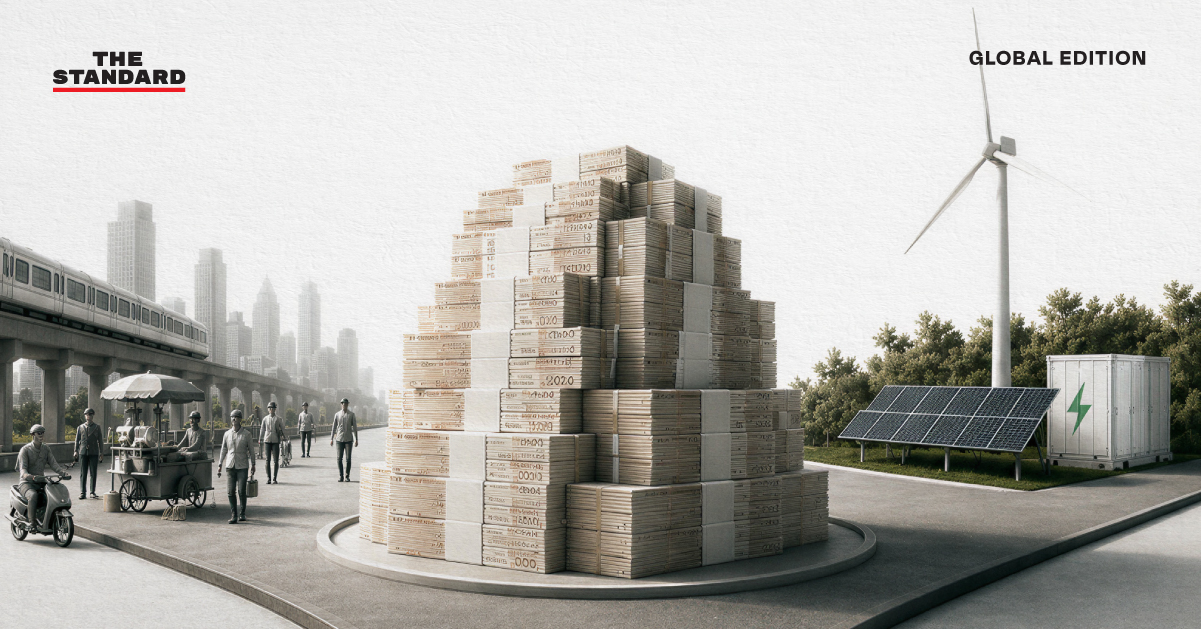
The much-debated FY2027 draft budget is currently testing the waters of a significant question for Thailand. Does fiscal policy still have the ability to support the country’s new growth model?
Key point
This is an important question following the Constitutional Court’s ruling in favor of the 400-billion-baht emergency loan decree.
Thailand, once the region’s more stable economies with low external debt and a resilient financial system, is undergoing changes. Stability is no longer a be all, end all definitive factor and the Thai economy is being hit from multiple angles.
Thailand is facing low growth, an aging population against low birth rates, high household debt and weak demand for private investment.
The FY2027 draft budget is therefore viewed as a signal of Thailand’s fiscal capacity. How much of the budget can be steered towards new growth engines, versus being spent maintaining the existing structure that may be running out of steam in a competitive new era.
The real question behind Thailand’s borrowing
The government’s rationale of borrowing 400 billion baht is not a small feat. Running a budget deficit against a fragile economy can be justified, the government has reasonable grounds considering the need for stimulus schemes, energy shock absorption and large-scale investments, but the question is whether additional borrowing generates meaningful returns.
When borrowed funds go toward raising a nation’s productivity, upgrading the workforce and building a stable digital infrastructure, debt can be a worthwhile bridge towards transition. However, debt can quickly become a burden if deployed for short-term subsidies and reinforcing existing programes with limited success.
When previous spending compromises the future
The FY2027 draft budget totals 3.788 trillion baht, broken down into 2.786 trillion baht in recurrent expenditure (73.6%), 789,171.5 million baht in capital investment (20.8%) and 151,520 million baht for principal (4%).
These figures are not indicative of a debt crisis, but they do reflect a squeezed budget with less wiggle room. The budget is being crowded by reuccrent spending, personnel costs, debt service and interest, meaning that the slice for new investments is becoming smaller.
There is an emerging challenge in the country’s spending patterns. Recurrent spending is necessary as it covers basic state obligations. However, when this slice outgrows the economy and government revenue, the budget gradually shifts into a vehicle that keeps the past afloat.
The government has to monitor this pattern, because it highlights how Thailand has less room for future-forward spending and long-term investments.
When Fiscal space narrows
Against all this, Thailand still maintains several fiscal strengths. Most of the country’s public debt is baht-denominated, there is low foreign currency risk and financial markets are absorbing the borrowing with stability.
This doesn’t mean there aren’t some red flags. Thailand’s public debt stood at 66.82% of GDP as of May 2026, below the 70% ceiling, but not by a wide margin.
Compared to neighboring countries, Thailand’s picture shows a shrinking fiscal space. Thailand’s public debt-to-GDP ratio is higher than Indonesia’s and the Philippines’, though still lower than parts of Malaysia’s. This suggests Thailand isn’t the most vulnerable in the region, but the country has spending constraints.
Through rising recurrent expenditure, increasing debt burden and interest payments, Thailand is gradually losing fiscal space. Without intervention, this can mount up to become a significant challenge.
A matter of ‘why’ in spending
The Constitutional Court ruled the 400 billion baht emergency decree constitutional, with the borrowed funds allocated for consumer subsidy measures and the clean energy transition.
On one hand, reducing energy costs and accelerating the shift to clean energy are reasonable goals, as Thailand remains heavily dependent on energy imports and is in need of transition. On the other side, emergency borrowing mechanisms require careful scrutiny, particularly as some conditions may not be deemed urgent enough to invoke fiscal powers.
The key argument here is that the government needs to clearly distinguish between strategic investments, short-term relief measures and low-return spending.
The strong case for a new growth model
Thailand needs sufficient scale and influx of new investment from both the public and private sectors.
Dr. Santitarn Sathirathai, Assistant Minister of Finance, stated that Thailand needs to raise its investment-to-GDP ratio from roughly 22–23% to 30%, a figure that reflects the urgent need for a new growth engine.
Attracting new investments will require an all-round review of conditions, from energy costs to digital infrastructure, regulatory clarity and policy continuity, all of which tie directly with the quality of budget spend. Structural reform and rapid upskilling will require investment into strategy, industries and equipment and resources have to be allocated with precision.
When ranked against ASEAN peers, it’s clear that Vietnam has an advanced manufacturing base, Indonesia has its vast market size and Malaysia is shifting toward high-value investment in electronics. Thailand is at risk of falling behind if the state is unable to commit to building new capabilities.
Political Will: The real litmus test
Fiscal policy reform is a reflection of political priorities. Each state project has key stakeholders, and each budget line has a direct beneficiary. This is the reason many governments choose to muddle through rather than pursue necessary structural reforms.
Thailand may not have the luxury of muddling through for much longer, and the runway is becoming limited. Whilst the country may not face an immediate fiscal crisis, it may gradually lose the ability to pursue its own vision for the future.
The most important question still remains unanswered. It’s not a matter of how much Thailand can borrow, but what the country gains from borrowing 400 billion Baht.
The fiscal 2027 budget is sending a clear signal that Thailand is teetering the lines between simply buying time, and investing in the future.
THE STANDARD Global Edition is produced in collaboration with Bitesize Bangkok