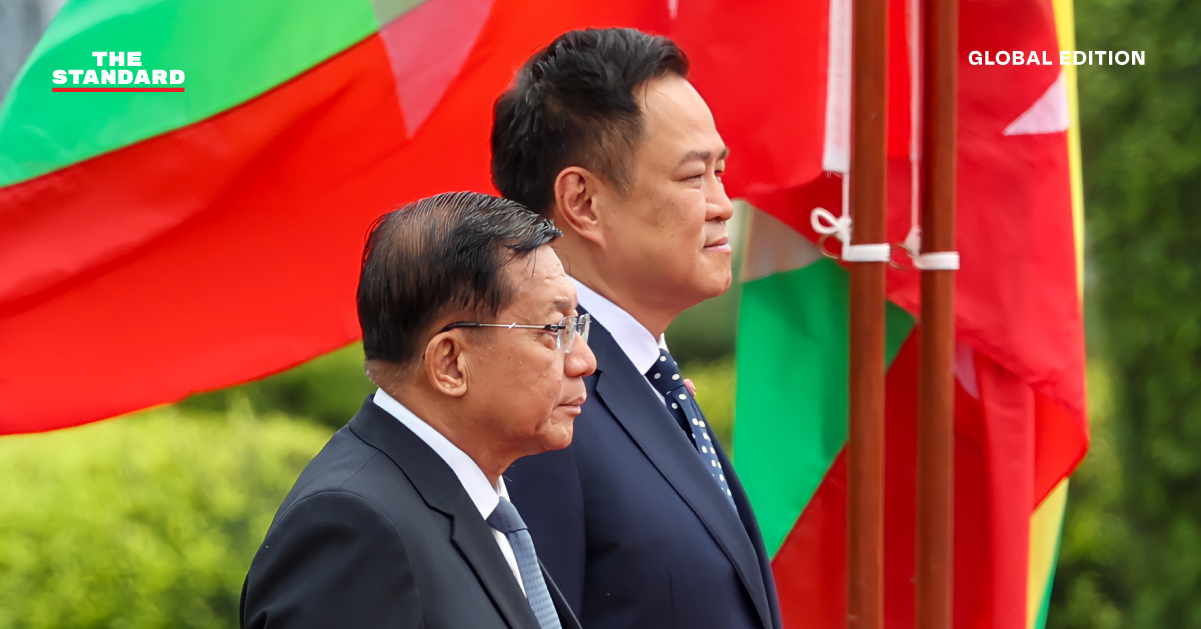
Myanmar’s junta chief-turned-President Min Aung Hlaing’s official visit to Thailand on August 6-7 marked a notable shift in Bangkok’s approach to Naypyidaw. As Myanmar’s military leadership seeks wider diplomatic acceptance following a controversial election and years of strained regional relations, the visit carried significance well beyond bilateral ties.
Key Point
Myanmar’s military leadership seeks to broaden its diplomatic reach following a controversial election and years of strained relations. This creates both opportunity and a high-stakes dilemma for Thailand.
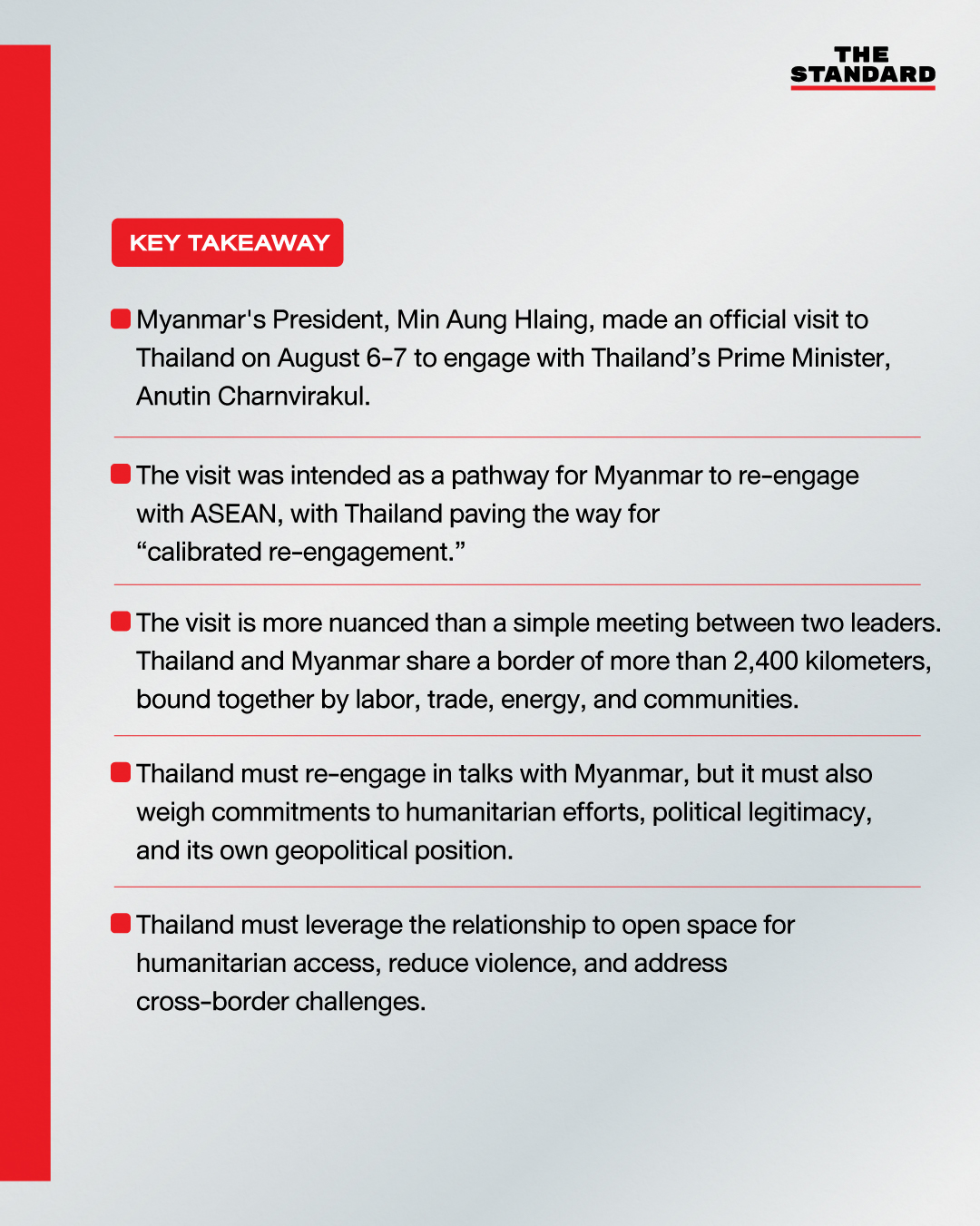
The visit itself is laced with complicated nuances for Thailand. Whilst there is no denying the value of a ‘calibrated re-engagement,’ a peek behind the rhetoric reveals the realities. Thailand and Myanmar share a border of more than 2,400 kilometers, bound together by labor, trade, energy and communities that live on both sides of the line. Conflict in Myanmar spills over into Thailand in the form of displaced citizens, narcotics, scam networks, haze, water pollution and security fears.
The Thai government has a duty to engage with the powers in Naypyidaw, because the costs also fall on Thai citizens and have far-reaching economic repercussions. This is the logic that supports Thailand’s calibrated re-engagement: a gradual return to dialogue that will attempt to balance geographic necessity against concerns over political legitimacy.
There’s a looming question for the government to answer here. The critical one is whether engagement will fuel change within Myanmar and along its borders, or help propel its military leadership’s diplomatic standing?
Thailand’s New Route for ASEAN
The recent visit has to be contextualized alongside ASEAN’s failure to move the Five-Point Consensus, adopted back in 2021. The consensus failed to move the needle for any negotiation. Fast forward to 2026, and ASEAN member states have resigned to the reality that after five years, progress has been limited. Thailand’s offer of re-engagement is an attempt to widen the channel for ASEAN.
The strategy here is therefore tied to ASEAN’s own inability to make progress on the Myanmar front.
In July, Thailand hosted an informal discussion between ASEAN foreign ministers and their Myanmar counterpart, insisting that direct contact should lead to trust-building, implementation of the Five-Point Consensus and meaningful progress. With this, Thailand takes on the ambitious role of a bridge between Myanmar and the rest of ASEAN.
Success in this sense would mean re-opened dialogue and action for humanitarian access, reduction of violence and tackling cross-border issues. If successful, then Thailand would be able to navigate ASEAN’s role in solving the ongoing crisis and optics with Myanmar.
If re-engagement amounts to merely leader-level welcome and economic activity without moving the needle on humanitarian efforts, then Thailand will risk being viewed as lenient.
If the route here re-engages Myanmar back into high-level regional diplomacy without progress across the areas of violence, humanitarian access or political dialogue, then the ASEAN region itself will be vulnerable.
If Thailand were to act as a bridge to ASEAN, then these conditions must be transparent. The line between re-engaging for improved conditions and endorsing has to be drawn.
Opportunities Without The Infrastructure
Economic potential took priority in the recent visit, with both sides expressing interest in reviving the Joint Trade Committee (JTC), which has been left dormant for over a decade. Thailand proposed that Myanmar ease import licensing for essential goods and machinery, whilst Min Aung Hlaiang extended an invitation for Thai investors to review the Dawei project.
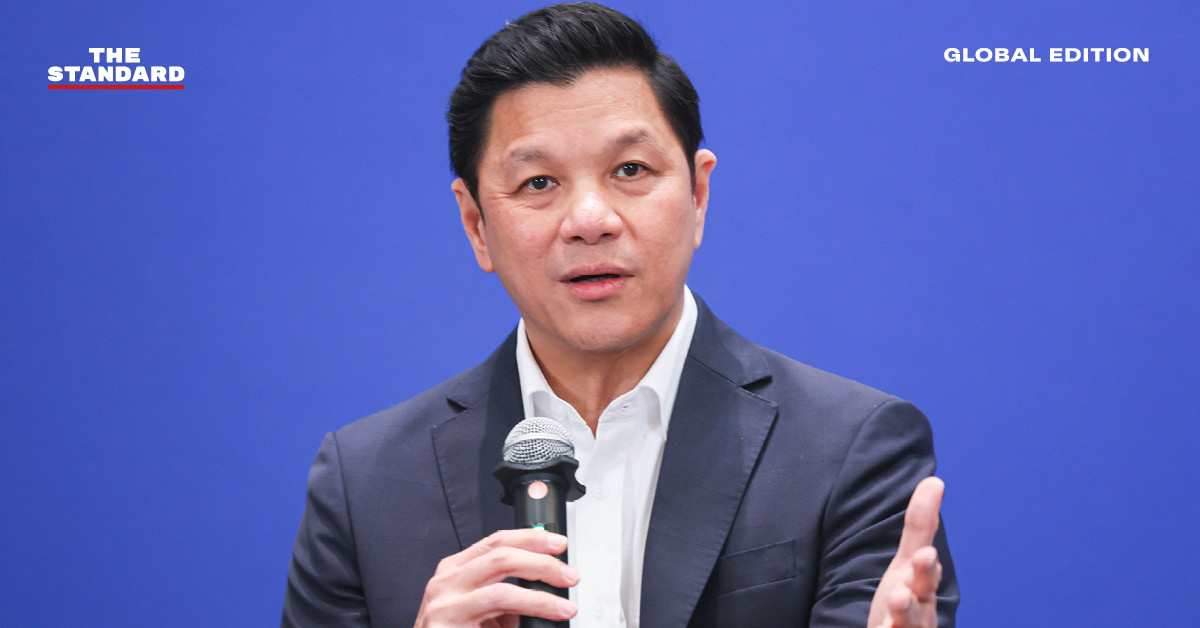
In an exclusive interview with THE STANDARD, Assoc. Prof. Nisit Panthamit, an economist at Chiang Mai University, described the current sentiment as an ‘open-curtain economy’, with businesses tentatively seeing glimpses of opportunity.
There are tangible possibilities here. Thailand’s capital, machinery, and manufacturing network matched with Myanmar’s labor, resources, and infrastructure opportunities. With prolonged stability, industries such as agriculture, retail, and health have potential.
The real issue at hand isn’t the shortage of any meaningful opportunity, though; it’s the pressing problem of financial infrastructure. In Myanmar, there are foreign-exchange restrictions, a significant gap between official and market exchange rates, and import licensing, making it extremely challenging for businesses to do business.
Whilst there have been attempts to legitimize payment channels, investors still need clarification on whether money can enter and move freely and whether the same rules will apply throughout certain periods.
Professor Nisit sees business readiness, but it would only be productive if Myanmar unlocks its financial system. Success in this regard should be measured by Myanmar’s establishment of its financial infrastructure and whether it can implement rules that allow corporations, foreign investors and institutions to conduct business.
Not Just an ASEAN Problem
The Thailand visit is also part of a wider diplomatic push by Min Aung Hlaing since assuming the Presidency, following a controversial election which has alienated Myanmar from the opposition, Western governments and human rights groups. The pursuit of legitimacy has led the President to China, India and Laos before arriving in Bangkok last week.
It speaks of a conflicting reality; the world doesn’t share the same stance on Myanmar. Whilst Western states continue to rely on sanctions and human rights pressures, neighboring countries like Thailand must maintain relations to manage security, energy, trade and their own geopolitical position. Thailand needs to think about our own dynamic with Myanmar and what it would mean for our country to remain engaged.
Meanwhile, the crisis itself is far from over. UNHCR estimates that as of mid-2026, roughly 3.7 million people are internally displaced, while the economy remains weakened by conflict, labor shortages, power cuts and energy pressure. Renewed diplomatic contact doesn’t mean complacency, but rather that its neighbors are finding ways to co-exist with the ongoing crisis.
Therefore, a friendly diplomatic engagement with business opportunities that doesn’t touch on humanitarian conditions and the impact on Myanmar’s citizens would in fact undermine both Thailand and ASEAN’s efforts.
Looking at Myanmar Through a Global Lens
What follows after the meeting in Bangkok will be closely watched by the world, and Thailand’s role as a bridge for Myanmar to ASEAN will also be determined by how we keep our neighbor accountable.
The world will be tracking measurable outcomes, with signs of Myanmar easing trade and foreign-exchange restrictions. Border trade will need to start moving through formal systems, not just informal channels, to improve ease of doing business. Secondly, there needs to be evidence of cross-border cooperation. Agreements on labor, water, and security should produce transparent and accountable monitoring processes.
With Thailand’s response in managing the fallout of scam networks also important, both countries will be accountable for dismantling scam networks and criminal operations linked to people in power.
Whilst geographical proximity gives Thailand concrete motivations to engage, it will also mean that consequences are greater if policies and communication fall through. As Thailand’s own reputation is directly impacted by refugee flows, illicit economies and transnational crime, it should give the country even more incentive to demand transparency in our dealings with Myanmar.
There has to be regional accountability. The looming question of whether re-engagement with Myanmar opens the space up for humanitarian assistance and negotiations remains: will things simply revert back to the way they were without Myanmar having to adhere to ASEAN’s political conditions?
Nevertheless, it’s important for Western countries to understand Thailand’s geographical exposure to Myanmar, and why we need to re-engage. Whilst the country cannot choose its neighbors, it’s within Thailand’s rights to determine the terms of the relationship and to keep our neighbor accountable for the course of action following last week’s re-engagements.
THE STANDARD Global Edition is produced in collaboration with Bitesize Bangkok