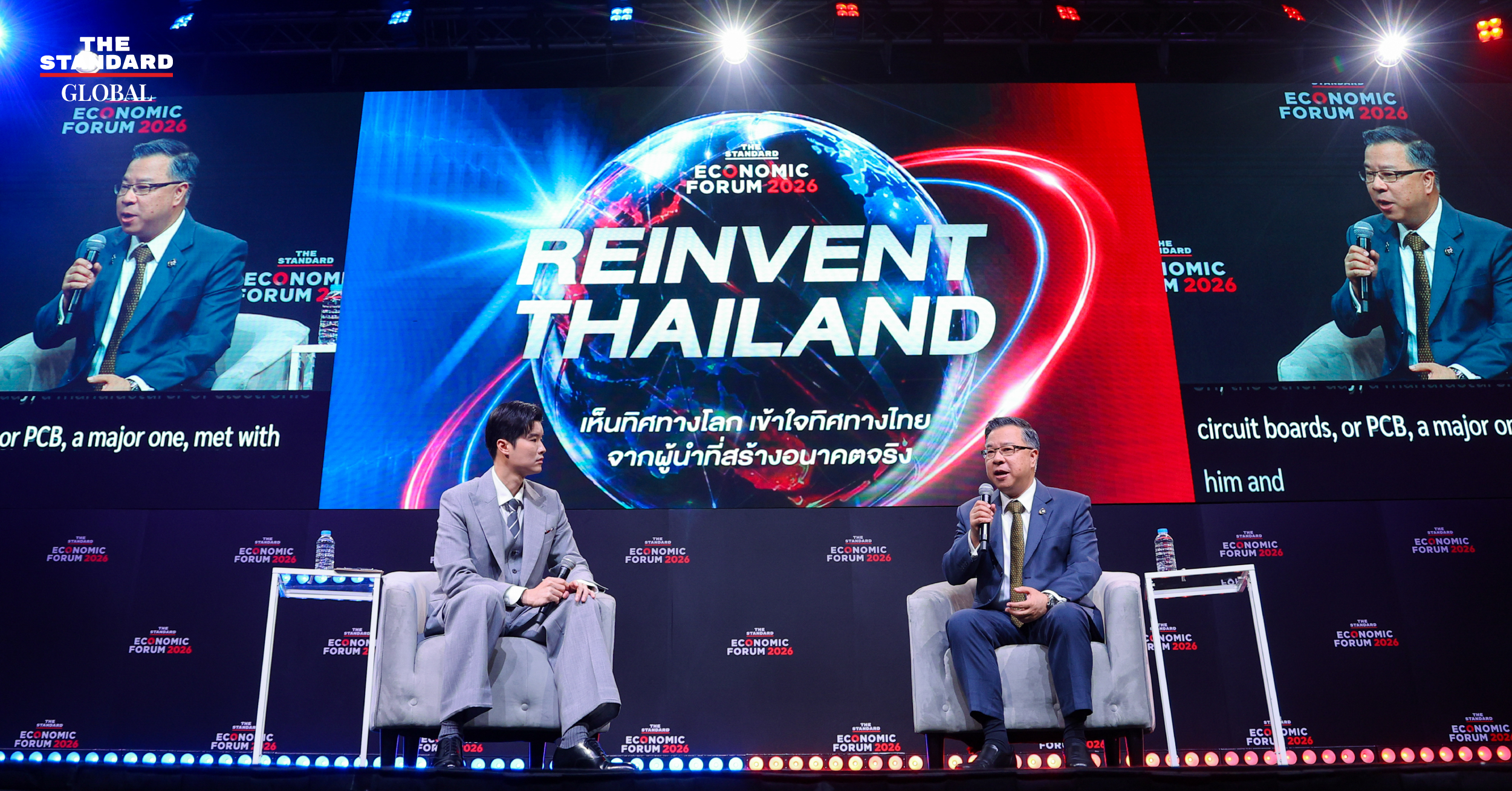


In an exclusive fireside chat on the third day of THE STANDARD ECONOMIC FORUM, tycoon Dhanin Chearavanont of CP Group outlined his vision for the future.
Key Point
“New technology and AI will increase everybody’s capability, as long as people learn to utilize it properly,” said Dhanin, while outlining Charoen Pokphand Group’s technology integration, where employees participate in global training courses to work more efficiently.
Although technology disruption may lead to short-term job losses, this should be temporary; new careers and business models will emerge in the future.
“Today, one or two people are able to use AI to produce short films and run their own businesses, with the technology working alongside them as their secretary or lawyer.”
A Humanoid Future
On robotics, Dhanin said he has formed a joint venture with a 33-year-old Chinese scientist, who was named one of China’s technology prodigies in 2025. The scientist, who co-founded a chip startup with his professor, sold the company for US$300 million when he was just 25. The joint venture aims to use robots to prevent errors and eliminate costs across key areas, from agriculture to factories and distribution centers, and, thirdly, across 7-Eleven stores, where they can cover late-night shifts for the 24-hour convenience store
“In the future, humanoid robots can be deployed as branch staff who provide excellent and friendly service, and can work 24 hours a day.”
Dhanin estimates that with AI helping to train robots, it now takes only 9–10 months to produce productive robots.
“By no more than ten years, humanoid robots will be able to match humans in terms of ability,” he says. Meanwhile, experts estimate that within three years, robots with human-like faces and facial muscles will be possible.
But these capable robots don’t need to be lifelike; they just need to work well and provide high-quality service. CP focuses on robots that are nimble, precise, error-free, and service-minded, rather than on making them resemble humans.
From a business perspective, it can add tremendous value as robots can work 24 hours a day, without missing work, and do not require labor benefits.
On Infrastructure That Will Power Innovation
From data centers to robots and electric vehicles, all these future-forward industries run on electricity. Therefore, Dhanin views that Thailand must prepare sufficient power generation to support incoming data investment from countries such as the US, China and Japan.
“CP Group itself needs to go into power generation to supply its own data centers,” said Dhanin, whilst noting that in the long term, he sees small nuclear reactors as a viable and safe way to bring down electricity prices.
The Future of Work & Productivity
Beyond future technologies, the fireside chat soon moved onto the future of work and the labor force.
Dhanin cited Shanghai’s Pudong district, whose economy is almost as large as Thailand’s, as a model for high productivity and efficiency. Pudong released guidelines to attract 40,000 skilled workers from China and abroad, which in turn created 200,000 jobs for new graduates, five times that number. In tandem, the government provided cost-of-living and housing support.
“Thailand can look to the Singapore model to attract five million skilled workers from across the world to live and work here,” he said. “This is just 7% of Thailand’s entire population.” Schemes like this would help offset low birth rates and create jobs without competing with the local market.
On government, Dhanin urged the public sector to transition from siloed working to end-to-end processes, appointing one person responsible from start to finish and covering the entire chain, suggesting shrinking the number of employed civil servants and increasing compensation for the remaining workforce.
CP Group has trimmed management layers from 5-6 to 2, so younger front-line employees can make quick decisions and solve problems on the spot, while AI tracks results.
“Guide, not dictate,” he said. “They’re on the front lines, and we’re behind the scenes.”