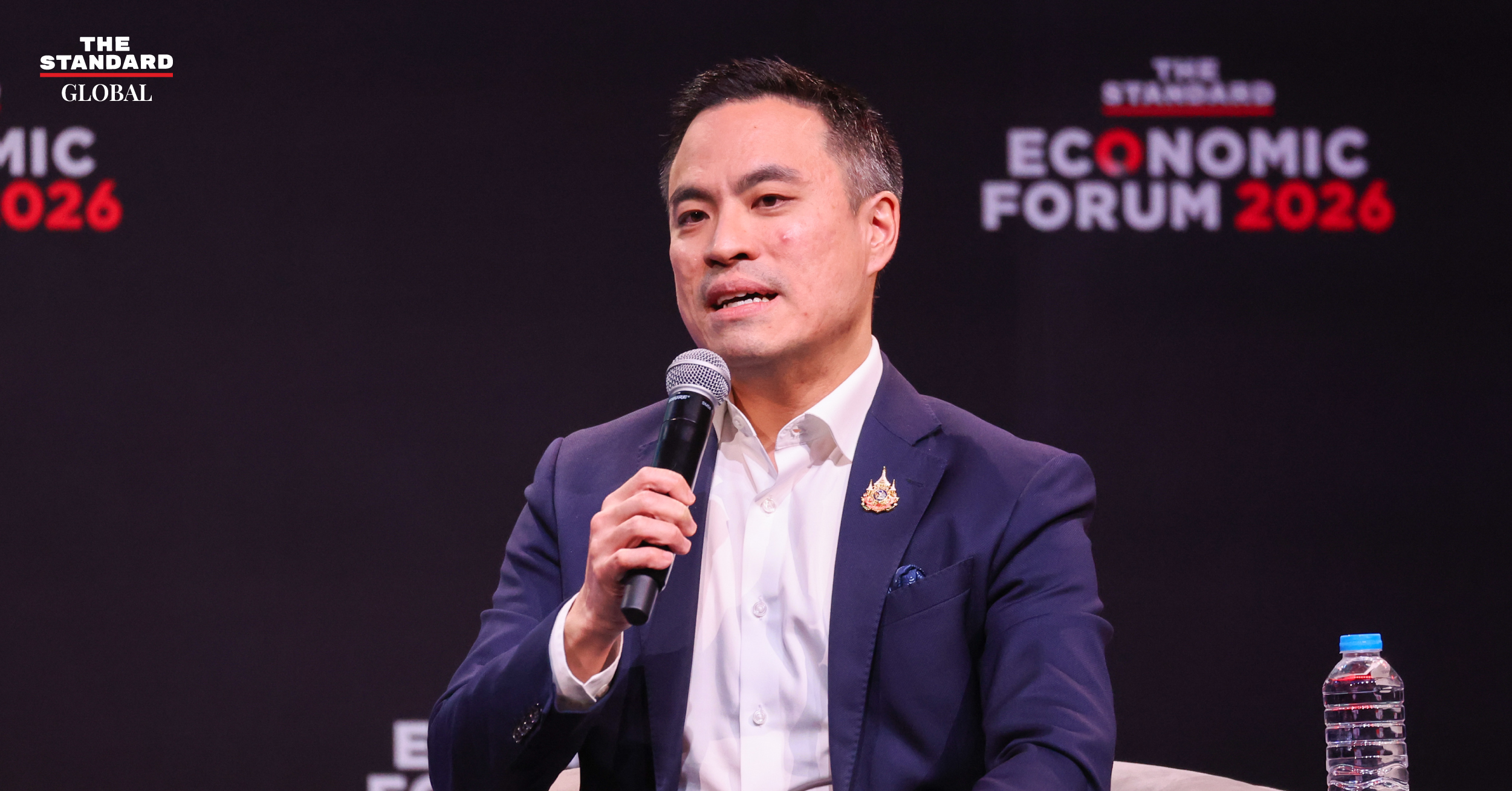


During a special keynote under “The Future of Thai Finance: Trust, Transparency & Growth” at THE STANDARD ECONOMIC FORUM 2026, Bank of Thailand Governor Vitai Ratanakorn addressed an increasingly “shock-prone world,” with economic crises and geopolitical conflicts now happening more frequently.
Key Point
With Thailand’s economy poised to expand by 2.4 percent this year and inflation within the 2.1 percent target range, growth remains too slow for SMEs and households to earn enough to cover costs.
This stalled growth sits at the heart of Thailand’s uneven K-Shaped recovery and deepens inequality.
A telling figure sits at the heart of this: AI-driven exports have ridden the AI wave and grown as much as 50 percent, whilst other categories hover in the 10 percent range. Large corporate entities are consistently posting strong profits, but smaller businesses are left out of the supply chain.
This has led the Bank of Thailand to expand its role beyond providing stability to supporting growth by cutting the policy rate twice and introducing targeted financial measures to tackle deeply rooted structural challenges.
Structural problems demand real response
“You cannot fix it by holding seminars,” the Governor says. He stressed that the issues holding the Thai economy back are deeply rooted and structural, something that we have heard often across public forums and panels.
Household debt, declining competitiveness, an aging society and corruption remain unsolved. These shortcomings can only be fixed through sustained action across every sector in the economy. Because structural reform doesn’t produce quick, tangible results, few are willing to take it on.
Choking the financial system’s channels: closing off laundering through cash and gold bars
The Governor acknowledged that money from corruption and grey-economy vehicles ultimately passes through financial institutions, prompting the BoT to break the chain at several points. Now, it has implemented enhanced due diligence when opening accounts, revoked the licenses of payment providers that process transactions for online gambling sites, and moved to block laundering through cash and other assets.
Results are already showing. Following the BoT’s requirement to state the purpose of cash withdrawals exceeding five million baht, large withdrawals fell by 57 percent, from an average of 100 billion baht a month to approximately 40 billion baht.
A separate regulation also requires reporting when someone withdraws 2 kilograms or more of gold bars acquired through digital platforms. From this, gold bar withdrawals dropped by 85 percent.
Thailand’s Informal Economy Problem
The Governor shared that Thailand’s informal economy is worth as much as 48 percent of Thailand’s GDP. 35 percent of that is general informal activity, whilst 13 percent is the grey economy.
A significant portion of informal businesses have viable potential, but only 34 percent can access credit from financial institutions.
“Future growth cannot come from rate cuts alone; it has to come from efficient allocation of capital and bringing viable informal businesses into the financial system.”
It’s the key to boosting Thailand’s productivity and strengthening confidence, together with trust in its financial system.