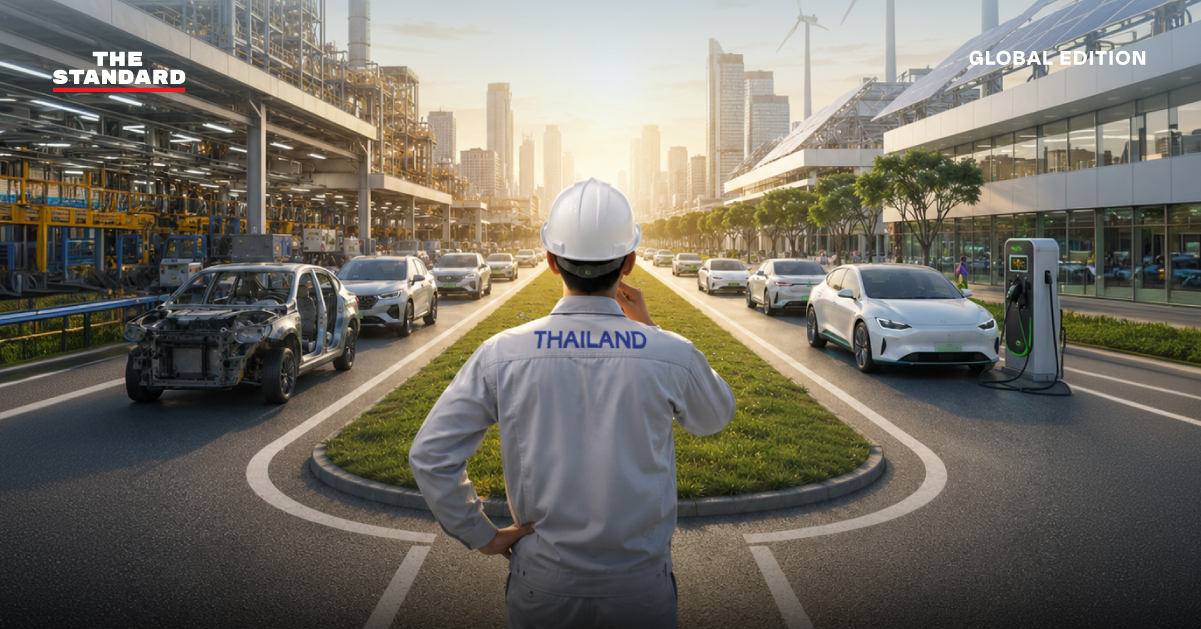
Thailand has once again found itself at a crossroads, as the country continues to face challenges across the automotive manufacturing sector, in which it once reigned supreme. Once hailed the ‘Detroit of Asia,’ Thailand is now tasked with navigating the transition to a new automotive era without dismantling the production base, supply chains, workforce, and domestic value-added it has spent 60 years building.
Key point
- Rewriting the Rules of a 60-Year Reign
- Into new Chinese EV territories
- From Two Million Units to a Structural Re-Design
- Sobering Realities: Shrinking Markets & Weakened Exports
- Structural Gaps in Thailand’s EV Landscape
- Why it All Matters
- Crossroad One: Accelerating EV Adoption Before Missed Opportunity
- Crossroad Two: Maintaining The Japanese Base
- Crossroads Three: Engineering a New Path
- Striking a Balance: The Detroit of Asia Looks Ahead
It’s not a simple question of choosing between Japanese automakers and Chinese EVs, either, but it’s forcing the country to examine how it wishes to navigate a new automotive landscape while maintaining its value add.
Reporting across multiple stakeholders, from EV specialists, the Federation of Thai Industries, automotive executives, and the Japanese Ambassador to Thailand, THE STANDARD finds the industry standing at three distinct crossroads.
The first requires rapid EV adoption so that Thailand can catch up in global automotive relevance. The second requires sustaining the existing Japanese anchored ecosystem, from hybrids to biofuels, and a vast supplier network that provides hundreds of thousands of jobs. The third is engineering a new competitive reality in which Thailand is not a market or assembly platform, but a country that can continuously provide value.
This is what’s truly at stake for the Detroit of Asia.
Rewriting the Rules of a 60-Year Reign
For decades, Thailand’s automotive industry was built on Japanese foundations. Institutional names such as Toyota, Honda, and Mitsubishi arrived in the 1960s and anchored Thailand’s entire industrial ecosystem, ranging from steel, wheels, plastics, to logistics.
However, the landscape has shifted in recent years. The Thai government moved towards electrification through its 30@30 policy, setting an ambitious zero-emission vehicle at 30% of total production capacity by 2030. Schemes such as EV 3.5 are layered in subsidies and tax incentives, designed to position Thailand as the region’s EV production hub.
Assoc. Prof. Dr. Yosapong Laoonual, Honorary President of the Electric Vehicle Association of Thailand, told THE STANDARD that Thailand’s EV market continues to expand year on year, fueled by state policies that provide incentives to manufacturers.
There are approximately 25 automotive brands in Thailand, with more than half being Chinese EV companies.
Into new Chinese EV territories
Thailand’s automotive landscape was built on six Japanese legacy brands: Toyota (including the Lexus luxury brand), Honda, Nissan, Mazda, Mitsubishi, and Isuzu. All these brands established themselves as household names for families across generations.
As the tide started turning on EVs, these companies also began competing with their own electric and hybrid models, from the Toyota bZ4X and Isuzu D-Max EV, but it’s been more of a cautious pivot rather than an aggressive push.
Meanwhile, Chinese EV production lines are operating predominantly in the EEC, transitioning beyond just selling.
The structural shift is significant. Thailand is treading away from Japanese industrial primacy to one that also houses Chinese EV capital.
The competition has a sharply defined apex. BYD has emerged as one of the most closely watched players in the global automotive industry, actively challenging Toyota across key markets. There is a global rebalancing underway, with Thailand among the most consequential arenas.
From Two Million Units to a Structural Re-Design
Thailand’s automotive industry is facing pressure from multiple angles. The market is facing weakened domestic purchasing power, tighter credit conditions, and heightened competition from imported vehicles.
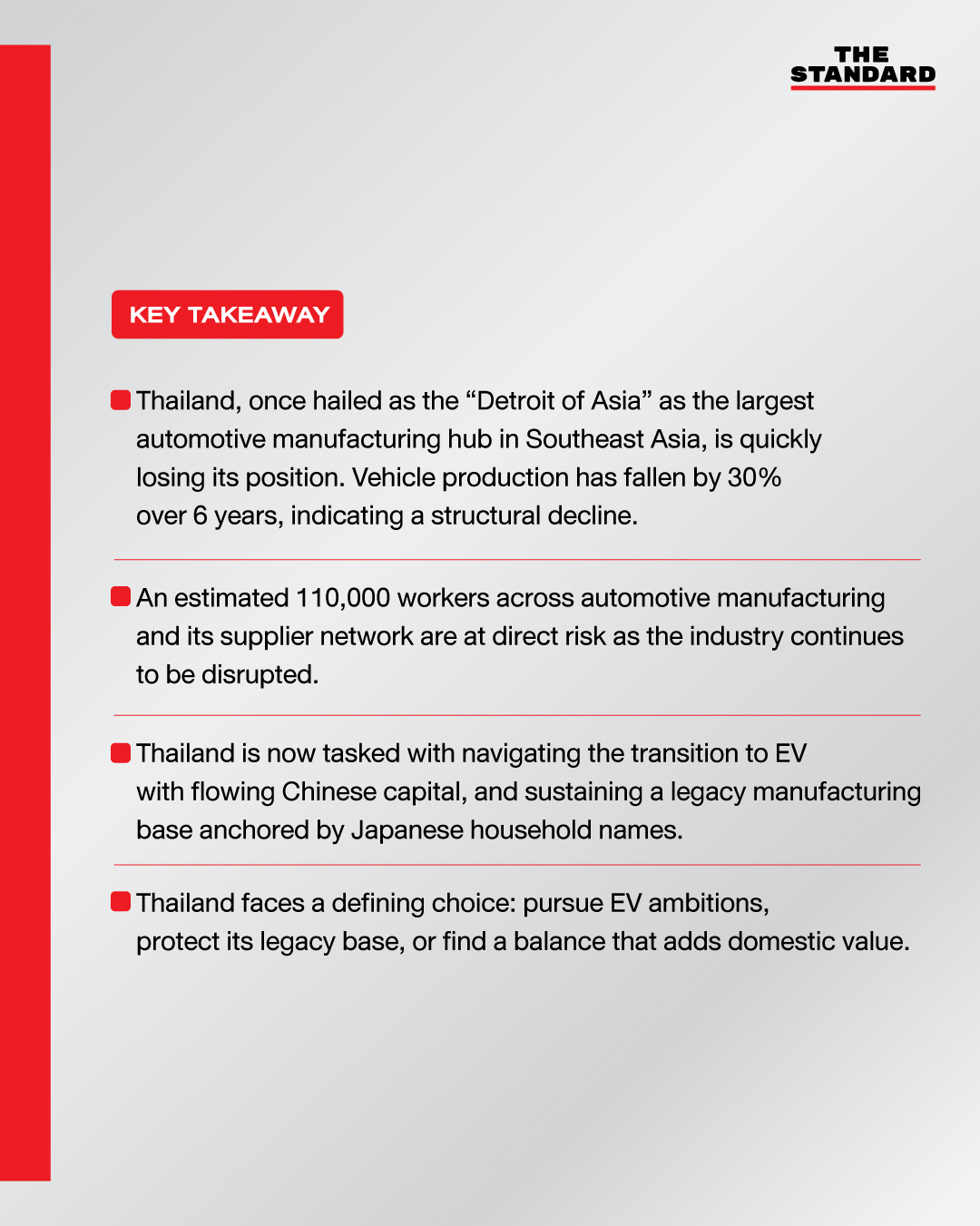
Industry data shows production falling from two million units in 2019 to approximately 1.4 million in 2025, 30% decline, with exports contracting to around 900,000 units.
The Japanese automakers have responded through structural shifts of their own. Honda has closed its Ayutthaya vehicle line and is consolidating production at Prachinburi, Nissan consolidated around its second plant, and Suzuki and Subaru also closed production plants.
Companies are shifting from volume production toward profitable models, tighter cost structures, and portfolio migration into hybrids, EVs, and alternative-fuel vehicles.
Sobering Realities: Shrinking Markets & Weakened Exports
In an interview with THE STANDARD, Surapong Paisitpatanapong, adviser to the chairman of the Automotive Industry Club and spokesperson for the Federation of Thai Industries, says the real concern here is the ongoing contraction in the domestic market. Sales of internal combustion engine passenger vehicles have fallen by over 24%, weighed down by weak purchasing power and continued credit tightening by financial institutions.
There’s a shock weaving across the entire supply chain. Automotive manufacturing in Thailand is structurally connected to steel, wheels, tires, and plastics, as well as the small traders that depend on factory activity around them. The entire ecosystem is vulnerable.
Structural Gaps in Thailand’s EV Landscape
Thailand’s EV infrastructure has not kept pace with the level of adoption. Thailand remains heavily import-dependent for battery cells and core technology, posing geopolitical risks to its supply chain. On charging, network expansion has been rapid but concentrated in major urban centers, lacking interoperability standards and still leaving consumers with fragmented apps and anxiety about long-distance travel.
Why it All Matters
Thailand’s automotive sector is a significant contributor to the country’s GDP and one that spans across manufacturing, materials, and production. It carries a market value of 2.1 trillion baht, supports approximately 2,400 companies across its supply chain, and employs 690,000 people.
The Thailand Automotive Institute estimates that up to 110,000 (15.3%) of the industry workforce are at risk of job loss without reskilling and structural support measures.
The automotive sector serves as a barometer of Thailand’s broader economic health, and weaknesses are evident at every level, from worker displacement to pickup truck sales.
Crossroad One: Accelerating EV Adoption Before Missed Opportunity
The logic here is simple. Thailand risks being displaced from the automotive industry altogether if it fails to adopt emerging technologies. The country is moving in that direction, having attracted 182 billion baht in EV investment applications between 2017 and March 2026, signaling that it retains strategic value for EV investors.
There are some risks embedded within these arrangements. Thai parts manufacturers have noted that EV growth has been partly driven by policy incentives, raising the question of how much of that benefit actually trickles down to local suppliers. If critical components, core tech and the likes of batteries continue to be imported, Thailand may never fully capture the value add as suggested by investment headlines.
Without a thoughtful structure, Thailand’s core value chain and its workers remain left out of the EV ecosystem.
Crossroad Two: Maintaining The Japanese Base
Masato Otaka, Japan’s Ambassador to Thailand, told THE STANDARD that Thailand should not read its automotive future through a singular lens.
The industry is moving away from single-technology mandates toward a multi-pathway approach: EV, hybrid, plug-in hybrid and biofuel running in parallel. EV is not a singular answer, says the Ambassador.
His counsel to Thailand is to hold its existing strengths: a deep and integrated automotive supply chain, competitive hybrid technology, and agricultural biofuel capacity that most competing nations cannot replicate.
The Japanese manufacturing base is woven into Thailand’s automotive infrastructure, sustaining thousands of workers and suppliers. A contraction of a category like pickup trucks would send shockwaves throughout the entire economy, from parts manufacturers to the workforce.
There is still a risk of over-protecting the legacy base, as technology adoption is needed to remain relevant in the new automotive world order. The critical question is how Thailand can leverage existing capabilities for the future.
Crossroads Three: Engineering a New Path
This is the most demanding crossroads, but the most consequential. It would demand Thailand to balance EV capital with Japanese legacy production, alternative energy and a local workforce altogether.
Success in the EV era should not be measured by how many manufacturers have entered the market or how many models have been launched. The metrics that matter should be on how well Thai suppliers are embedded in EV supply chains and whether Thai workers are being reskilled to fit the new demands of this economy.
The government’s new automotive finance scheme, ‘old car for new’ aims to tackle key structural issues of PM2.5, energy transition, and lagging growth. If well implemented, the scheme could stimulate domestic demand. However, more work needs to be done.
Striking a Balance: The Detroit of Asia Looks Ahead
The world is rapidly adopting EVs, and geopolitical realities have only strengthened the case for them. However, Thailand isn’t choosing between EV and ICE or between two powerful Asian nations. The country has to take this opportunity of transition to undertake policy design with multiple trajectories.
As Thailand’s automotive industry currently stands at three crossroads, the country has to make a decision. Crossroad One would see rapid EV adoption, the second would see Thailand sustain the Japanese anchor and the third would see the country engineer a new equilibrium with skin in the game.
The broader question of whether Thailand intends to be a significant player in the regional automotive value chain remains.